![How to Use Active Recall: Boost Retention 2-3x [2026 Guide]](/thumbnails/how-to-use-active-recall.webp)
You’ve spent hours re-reading your notes, highlighting key points, and making beautiful study guides—only to blank on exam day.
The problem isn’t your effort; it’s that passive review doesn’t create lasting memories. Your brain needs to actively retrieve information to strengthen neural pathways.
This guide will show you exactly how to implement active recall, the study technique that research shows improves retention 2-3 times more than traditional methods.
Active recall is a study method where you continuously test yourself by retrieving information from memory instead of passively reviewing notes. To use it: 1) Read your study material once, 2) Close your notes, 3) Write or speak everything you remember, 4) Check for gaps, 5) Repeat at increasing intervals.
What is Active Recall? (The Science Behind It)
Active recall is a learning technique based on retrieval practice—the act of pulling information from your memory rather than simply reading it again.
Unlike passive review methods like re-reading, highlighting, or making summaries, active recall forces your brain to work. Every time you successfully retrieve a piece of information, you strengthen the neural pathways associated with that memory.
This is called the testing effect, and the research is compelling. Students who used active recall remembered 80% more than those who re-read material, and remembered 80% of material a week later compared to just 36% for passive studying, according to research from Birmingham City University.
Long-term retention using active recall can be 2-3 times greater than traditional methods like rereading, as confirmed by a 2024-2026 systematic review on active recall strategies and academic achievement.
Why Active Recall Works Better Than Re-Reading
When you re-read your notes, your brain recognizes the information and gives you a false sense of knowing. Recognition feels like understanding, but it doesn’t test whether you can actually retrieve the information when you need it.
Active recall creates desirable difficulty—the struggle to remember forces your brain to strengthen connections. The harder you work to retrieve information (within reason), the stronger the memory becomes.
Think of it like strength training for your memory. Just as lifting weights builds muscle, retrieving information builds memory strength.
7 Proven Active Recall Techniques You Can Start Today
Different active recall study method approaches work for different learning styles and subjects. Choose one technique to master first, then experiment with others to find what works best for you.
Each technique follows the same core principle: test yourself before you feel ready.
1. Flashcards (The Classic Method)
Flashcards are the most popular active recall technique for good reason—they’re simple, versatile, and proven effective.
Flashcards were found to correlate with higher GPA and test scores in a 2024 systematic review on active recall strategies.
How to create effective flashcards:
- Write one question or concept per card (avoid cramming multiple ideas)
- Use your own words rather than copying textbook definitions
- Include context and examples, not just isolated facts
- Create “why” and “how” questions, not just “what” questions
Digital vs. physical flashcards: Digital flashcards (like Anki, Quizlet, or Remnote) can automatically schedule reviews using spaced repetition algorithms. Physical cards give you tactile engagement and no screen distractions.
Organize cards into three piles: know it well, somewhat know it, and don’t know it. Focus your study time on the “don’t know it” pile.
2. The Blurting Method
The blurting method is perfect when you’re studying from textbooks or lecture notes and don’t have flashcards ready.
Step-by-step process:
- Read a section of your material once (don’t try to memorize)
- Close your book or notes completely
- Set a timer for 5-10 minutes
- Write down everything you remember about the topic
- Open your notes and check what you missed
- Re-study the gaps in a different color
- Repeat the process 24 hours later
This active recall for students technique is especially effective for essay-based subjects where you need to understand relationships between concepts, not just memorize facts.
The key is to resist the urge to peek. The discomfort of trying to remember is exactly what builds memory strength.
3. Practice Questions and Past Papers
If your goal is exam performance, practice questions are the most direct form of active recall.
Where to find practice questions:
- Official past exam papers from your instructor or institution
- End-of-chapter questions in textbooks
- Online question banks for standardized tests
- Study guides and workbooks for your subject
Creating your own practice questions: Turn statements in your notes into questions. For example, “Mitochondria produce ATP” becomes “What organelle produces ATP?” and “What does the mitochondria produce?”
Simulate exam conditions: time yourself, remove all notes, and grade yourself honestly. This builds both knowledge and test-taking stamina.
4. The Feynman Technique
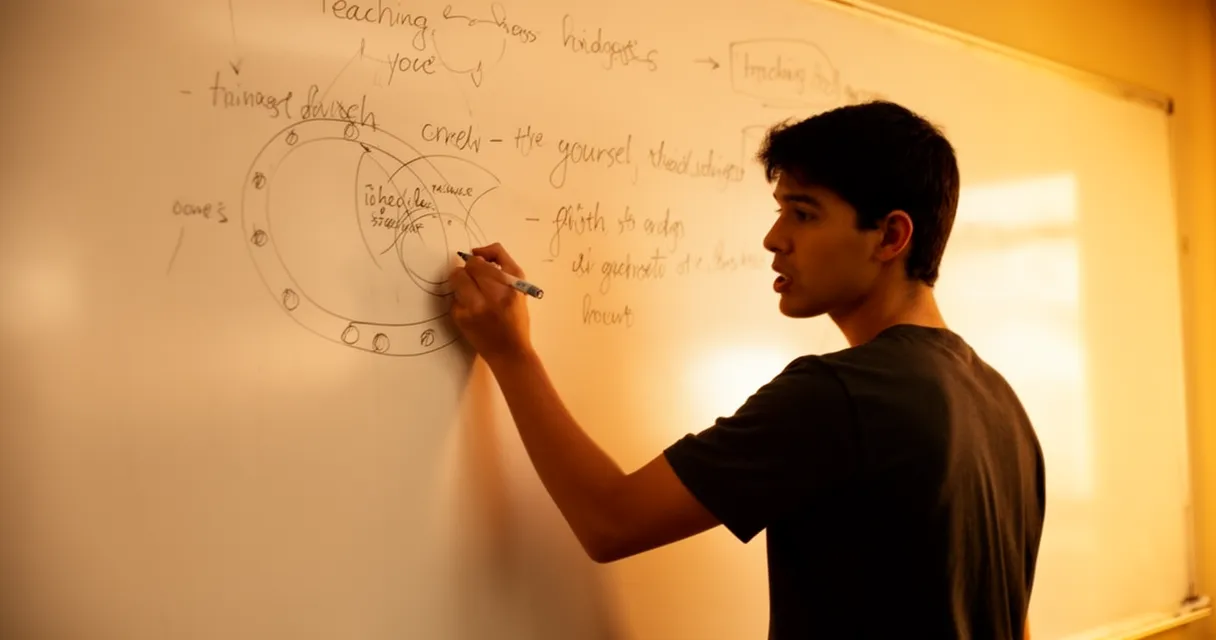
Named after physicist Richard Feynman, this active recall technique forces you to explain concepts in simple language—revealing gaps in your understanding.
How to practice active recall using the Feynman Technique:
- Choose a concept you need to learn
- Explain it out loud (or in writing) as if teaching a 10-year-old
- Identify areas where you struggle to simplify or use jargon
- Go back to your materials and re-learn those specific areas
- Repeat until you can explain it clearly without notes
This technique is particularly powerful for complex subjects like physics, economics, or philosophy where understanding relationships matters more than memorizing facts.
Record yourself explaining concepts, then listen back. You’ll immediately notice where your explanation becomes unclear or where you rely on vague language.
5. Self-Quizzing from Headings
This is the fastest active recall study method to implement—you don’t need any special materials.
How it works:
- Look at the headings and subheadings in your textbook or notes
- Turn each heading into a question
- Close the material and answer the question from memory
- Check your answer and note what you missed
- Move to the next heading
For example, if a heading says “The Water Cycle,” ask yourself: “What are the stages of the water cycle?” “How does water move between the atmosphere and Earth?” “What drives the water cycle?”
This technique works especially well for last-minute review before exams when you don’t have time to create elaborate study materials.
6. Mind Mapping from Memory
Visual learners often find mind mapping to be the most effective active recall for students approach.
The process:
- Write the main topic in the center of a blank page
- Without looking at notes, add branches for subtopics
- Add details, examples, and connections from memory
- Use a different color to fill in what you forgot
- Redraw the entire map from memory the next day
Mind maps reveal not just what you remember, but how well you understand connections between ideas—critical for subjects like history, biology, and literature.
Use symbols, drawings, and colors to make concepts memorable. The act of creating visual representations engages different parts of your brain than pure text.
7. Cornell Note Recall Column
If you already use the Cornell note-taking system, you have a built-in active recall tool.
How to use the recall column:
- Review your main notes section
- Write questions or key terms in the left recall column
- Cover the main notes with your hand or paper
- Answer the questions using only the recall column cues
- Check your answers and mark what you got wrong
If you’re not using Cornell notes yet, consider adopting this system—it’s designed specifically to support active recall and spaced repetition.
How to Use Active Recall for Different Subjects
The core principle stays the same across subjects, but implementation varies based on what you’re learning.
Active Recall for Math and STEM
Mathematics and science require understanding processes and applying concepts, not just memorizing facts.
Effective STEM active recall techniques:
- Work practice problems from memory first: Try solving problems without looking at your notes or examples. Only check the method after you’ve attempted it.
- Explain formulas verbally: Don’t just memorize equations—explain in your own words why each component exists and what it represents.
- Derive formulas from first principles: Instead of memorizing the quadratic formula, practice deriving it from completing the square.
- Teach problem-solving steps out loud: Walk through each step as if teaching someone else, explaining your reasoning.
A 2025-2026 physics study found students using active recall scored 8.33 compared to control group’s 4.13 (t-value 2.23, significant at 0.05 level), according to research published in the Multiresearch Journal.
AI tools for STEM practice: Use ChatGPT or Claude to generate practice problems at various difficulty levels. Ask the AI: “Generate 5 calculus problems involving the chain rule with varying difficulty” or “Create physics word problems about momentum conservation.”
Active Recall for Humanities and Social Sciences
Essay-based subjects require synthesizing information and constructing arguments from memory.
Humanities-focused techniques:
- Essay planning from memory: Without notes, outline an essay on a past exam question. Include thesis, main arguments, and supporting evidence.
- Timeline construction: Draw historical timelines from memory, then check for missing events and incorrect dates.
- Theory comparison tables: Create comparison charts of different theories, philosophers, or historical interpretations from memory.
- Argument reconstruction: Read a scholarly argument once, then explain it in your own words without looking back.
The Feynman Technique works exceptionally well here—explaining complex theories in simple terms reveals whether you truly understand the underlying concepts.
Active Recall for Languages
Language learning is built on retrieval practice—every time you recall a word or grammar rule, you’re using active recall.
Language-specific techniques:
- Vocabulary flashcards with context: Don’t just memorize isolated words. Include example sentences and common collocations.
- Grammar rule application: Cover the rule explanation and try to construct correct sentences from memory.
- Translation practice: Translate passages without looking at vocabulary lists first.
- Speaking from memory: Describe your day or explain a topic in the target language without preparation.
AI language practice tools: Use AI language tutors like ChatGPT for conversation practice, grammar corrections, and generating custom exercises. Ask for: “Correct my French and explain errors” or “Generate 10 Spanish sentences using the subjunctive mood.”
Combining Active Recall with Spaced Repetition
Active recall tells you how to study. Spaced repetition tells you when to study.
When you combine these two effective study techniques, you create a powerful system that maximizes long-term retention while minimizing study time.
Why the combination works: Active recall strengthens memories through retrieval. Spaced repetition schedules those retrievals right before you’re about to forget—the optimal time for reinforcement.
The forgetting curve shows that without review, you forget about 50% of new information within a day and 90% within a week. Strategic review sessions interrupt this decline.
The Optimal Review Schedule
Use this spacing pattern to practice active recall and spaced repetition together:
- Day 1: Initial learning and first active recall session
- Day 2: Second recall session (24 hours later)
- Day 4: Third session (2-3 days after second)
- Day 7: Fourth session (one week after initial)
- Day 14: Fifth session (two weeks after initial)
- Day 30: Final reinforcement (one month after initial)
Adjust this schedule based on difficulty. Challenging concepts need more frequent review, while easier material can have longer gaps.
AI-powered spacing algorithms: Apps like Anki use machine learning to optimize your review schedule automatically. The algorithm tracks which cards you struggle with and schedules them more frequently.
How Long Should Active Recall Sessions Be?
Quality matters more than quantity with active recall. Short, focused sessions beat marathon study sessions every time.
Recommended session structure:
- 20-30 minute focused blocks for intensive recall practice
- 5-10 minute breaks between sessions to prevent mental fatigue
- Maximum 2-hour total per subject in one day
Your brain fatigues quickly when working hard to retrieve information. After 30 minutes, your recall efficiency drops significantly.
Balancing initial learning with recall practice: Spend roughly 50% of your study time on initial learning (reading, lecture notes, understanding concepts) and 50% on active recall practice. Many students make the mistake of spending 90% on passive review and only 10% on active testing.
For exam preparation, flip this ratio to 30% reviewing material and 70% practicing recall in the final week.
Common Active Recall Mistakes (And How to Avoid Them)
Even students who understand active recall often implement it incorrectly. Avoid these pitfalls to maximize effectiveness.
Mistake 1: Not allowing enough struggle time Don’t check answers after just 10 seconds of thinking. Give yourself 30-60 seconds to struggle with retrieval. The productive struggle is what builds memory strength.
Mistake 2: Looking at answers too quickly When you can’t remember something, resist peeking immediately. Try approaching the question from different angles, connecting it to related concepts, or breaking it into smaller parts first.
Mistake 3: Only using recognition, not full recall Multiple-choice questions test recognition (easier), while open-ended questions test recall (harder but more effective). Prioritize fill-in-the-blank and short-answer formats over multiple choice when possible.
Mistake 4: Creating ineffective questions Vague questions like “What is photosynthesis?” yield vague answers. Better: “What are the reactants and products of photosynthesis, and where does each stage occur in the chloroplast?”
Mistake 5: Giving up when it feels difficult Active recall should feel harder than re-reading. If it feels easy, you’re likely not challenging yourself enough. The discomfort means it’s working.
Mistake 6: Not reviewing incorrect answers thoroughly When you get something wrong, don’t just read the correct answer once. Understand why you got it wrong, re-study the concept, and test yourself again within 24 hours.
Creating Your Active Recall Study Materials
The biggest barrier to implementing active recall is the time investment in creating study materials. Here’s how to organize your notes effectively and transform them into powerful recall tools.
Identifying what to turn into questions:
- Main concepts and definitions
- Cause-and-effect relationships
- Step-by-step processes
- Important dates, names, or formulas
- Comparisons and contrasts
- Arguments and supporting evidence
Skip these for active recall:
- Minor details that don’t support main concepts
- Examples that simply illustrate a point you already understand
- Background information you already know well
Question types to create:
- Factual: “What is…?” “Who discovered…?” “When did…?”
- Conceptual: “Why does…?” “How does X relate to Y?” “What’s the difference between…?”
- Application: “How would you solve…?” “What would happen if…?” “Apply this concept to…”
Focus most of your questions on conceptual and application levels—these create deeper understanding than pure memorization.
Automating Flashcard Creation from Your Notes
The setup time for active recall prevents many students from using it consistently. You might have dozens of pages of notes that need to be converted into hundreds of flashcards.
AI-powered flashcard generation solves this friction. Instead of manually creating study guides from your notes and typing each flashcard, modern tools can analyze your notes and automatically generate practice questions.
How AI flashcard generation works:
- Upload your lecture notes, textbook highlights, or study materials
- AI analyzes the content and identifies key concepts
- Generates questions at multiple difficulty levels
- Creates flashcards ready for spaced repetition practice
Tools like ChatGPT, Claude, and specialized education AI can turn your notes into flashcards in minutes instead of hours. Simply paste your notes and prompt: “Create flashcards from these notes with questions and answers” or “Generate 20 practice questions covering these concepts.”
The benefit: You spend your limited study time actually practicing recall rather than formatting flashcards. Setup time drops from hours to minutes, removing the main barrier to consistent active recall practice.
For more advanced generation, use prompts like: “Create a mix of factual, conceptual, and application questions from these biology notes” or “Generate flashcards with increasing difficulty levels.”
Frequently Asked Questions
What is active recall and how does it work?
Active recall is a study method based on retrieval practice—testing yourself by pulling information from memory rather than passively reviewing notes. It works by strengthening neural pathways through the testing effect: each time you successfully retrieve information, your brain reinforces that memory. This is far more effective than recognition-based methods like re-reading, which create a false sense of knowing.
How do I use active recall in math and other STEM subjects?
Focus on practice problems rather than flashcards. Work problems completely from memory first before checking your notes or solutions. Explain formulas and concepts verbally in your own words rather than just memorizing equations. Try deriving formulas from first principles instead of memorizing them. The goal is understanding processes and applying concepts, not just recalling facts.
What are the best methods of using active recall to study for a test?
Use flashcards for factual information and definitions. Practice questions and past papers for application and exam simulation. The blurting method works well for essay subjects—write everything you remember, identify gaps, and re-study. Combine any method with spaced repetition by reviewing at increasing intervals (24 hours, 3 days, 1 week, 2 weeks). Mix multiple techniques based on what your exam will actually test.
How do I incorporate active recall and spaced repetition together?
Use active recall as your study method (flashcards, practice questions, blurting, etc.) and spaced repetition as your timing schedule. Review material using active recall techniques at increasing intervals: Day 1 (initial learning), Day 2, Day 4, Day 7, Day 14, and Day 30. The spacing interrupts the forgetting curve right before you’re about to forget, making each review session maximally effective. Apps like Anki automate this scheduling.
What are some ways to use active recall besides flashcards?
The blurting method (write everything you remember about a topic), practice questions and past papers, the Feynman Technique (explain concepts as if teaching a beginner), mind mapping from memory, self-quizzing using textbook headings, and the Cornell note recall column. Choose based on your subject—mind maps work well for interconnected concepts, blurting for essays, and practice problems for math.
How long should I spend on active recall sessions?
Aim for 20-30 minute focused sessions with 5-minute breaks between them. Active recall is mentally demanding, so your efficiency drops after 30 minutes of intensive practice. Maximum 2 hours total per subject per day. Balance your time: spend about 50% on initial learning (reading, understanding) and 50% on active recall practice. In the week before exams, shift to 30% review and 70% active recall.
Is active recall better than re-reading notes?
Yes—research shows active recall produces significantly better retention. Studies found students using active recall remembered 80% of material a week later compared to just 36% for passive studying. Long-term retention can be 2-3 times greater than re-reading. Re-reading creates recognition (“this looks familiar”) but doesn’t test retrieval (“can I remember this when I need it?”). Active recall is also more time-efficient—you learn more in less study time.
Conclusion
Active recall forces your brain to retrieve information, creating stronger memories than passive review ever could. The research is clear: you’ll remember 2-3 times more using how to use active recall techniques than traditional re-reading methods.
Start with one technique—flashcards or the blurting method work well for beginners—and gradually incorporate others as you build confidence. Combine active recall with spaced repetition for maximum long-term retention.
Expect initial difficulty. If active recall feels harder than your usual study methods, that’s actually a good sign. The productive struggle is what builds lasting memory.
Start your first active recall session today: Choose one topic from your notes, close them completely, and write everything you remember. Check for gaps, re-study those areas, and repeat tomorrow. You’ll be surprised how much more you remember next week.