Most students read their textbook the same way they scroll social media — eyes moving, brain barely engaged.
You’ve spent hours on a chapter and still can’t remember a single key concept. That’s not a focus problem; it’s a method problem. Passive reading feels productive, but without a system, almost nothing sticks.
In this guide you’ll learn a proven, step-by-step system to read textbooks faster, retain dramatically more, and turn every reading session directly into study materials you can actually use.
The short answer: To read a textbook effectively, preview the chapter before you start, turn headings into questions, read actively to answer those questions, recite key points from memory after each section, and review your notes. This SQ3R-based approach moves information from short-term to long-term memory instead of letting it evaporate.
Why Most Students Read Textbooks Wrong (And Why It’s Not Their Fault)
Passive reading — eyes scanning the page while your mind wanders — feels like studying. It isn’t.
The brain treats unstructured text as low-priority noise unless it’s given a retrieval task to anchor to. Without a question to answer or a goal to chase, your brain has no reason to hold onto what it’s reading.
The numbers back this up. According to ERIC and Higher Education Reading Research, only 30% of college students regularly complete assigned textbook readings, while 85% of faculty assume students are reading. That gap doesn’t just reflect a motivation problem — it shows how many students try to read without a system, find it unrewarding, and quietly give up.
The fix isn’t willpower. It’s method.
Before You Start: How to Preview a Textbook Chapter
Before you read a single word of body text, spend 2–3 minutes previewing the chapter. This primes your brain to recognize and retain relevant content when it appears.
Here’s what to scan during your preview:
- Chapter title and all H2/H3 headings — these are the skeleton of the author’s argument
- Bolded terms and key vocabulary — they signal what the author considers essential
- End-of-chapter questions or summary — read these first so you know what you’re being tested on
- Figures, charts, and captions — visuals often compress the chapter’s core data into one image
This 2-minute investment pays dividends for the next hour of reading.
The 5-Minute-Per-Page Time Formula
Before you sit down to read, estimate how long the session will actually take. Multiply the total number of pages by 5 minutes to get a rough estimate.
A 12-page chapter? That’s about 60 minutes of focused reading — not including review.
Now break that time into 25–45 minute focused blocks with 5-minute breaks between them. This is Pomodoro-friendly and prevents the comprehension drop that kicks in after an hour of continuous reading. Planning realistic sessions means you’re less likely to rush, zone out, or quit early.
The SQ3R Method: The Most Effective Way to Read a Textbook
SQ3R — Survey, Question, Read, Recite, Review — is the most research-backed framework for how to read a textbook effectively. Developed by educational psychologist Francis Robinson in 1941 and validated by decades of cognitive research, it transforms reading from a passive activity into an active retrieval exercise.
Here’s what each step means in practice:
- Survey: Skim headings, boldfaced terms, and visual elements before you read a single sentence of body text.
- Question: Before reading each section, convert its heading into a question. “Cellular Respiration” becomes “What is cellular respiration, and why does it matter?”
- Read: Read the section with one goal — answering the question you just asked. You’re not trying to finish the page; you’re trying to find the answer.
- Recite: Close the book. Say the answer aloud in your own words, or write it down. This is the most skipped step and the most important one for retention.
- Review: After completing the chapter, revisit every question and recite the answers again without looking at your notes.
According to Cornell College Academic Skills research based on Robinson’s Effective Study method, students who recite after every section remember approximately 80% of the material after one week and 70% after two months — far outperforming the steep forgetting curve of passive readers.
SQ3R in Practice: A Worked Example
Let’s say you’re reading a biology chapter with the heading: “The Role of Mitochondria in Cellular Energy Production.”
Here’s SQ3R applied step-by-step:
- Survey: You’ve already previewed the chapter and noticed a diagram of the ATP cycle. Good.
- Question: You convert the heading — “What role do mitochondria play in producing cellular energy?”
- Read: You read the section looking specifically for the answer to that question, not every detail.
- Recite: You close the book and say out loud: “Mitochondria are the powerhouses of the cell — they convert glucose into ATP through cellular respiration, which the cell uses as energy.”
- Review: At the end of the chapter, you come back and recite your answer again without peeking.
That’s one section done — retained, not just read.
Active Reading Strategies to Lock In What You Learn
Active reading means interacting with the text, not just moving through it. These strategies work alongside SQ3R to deepen comprehension.
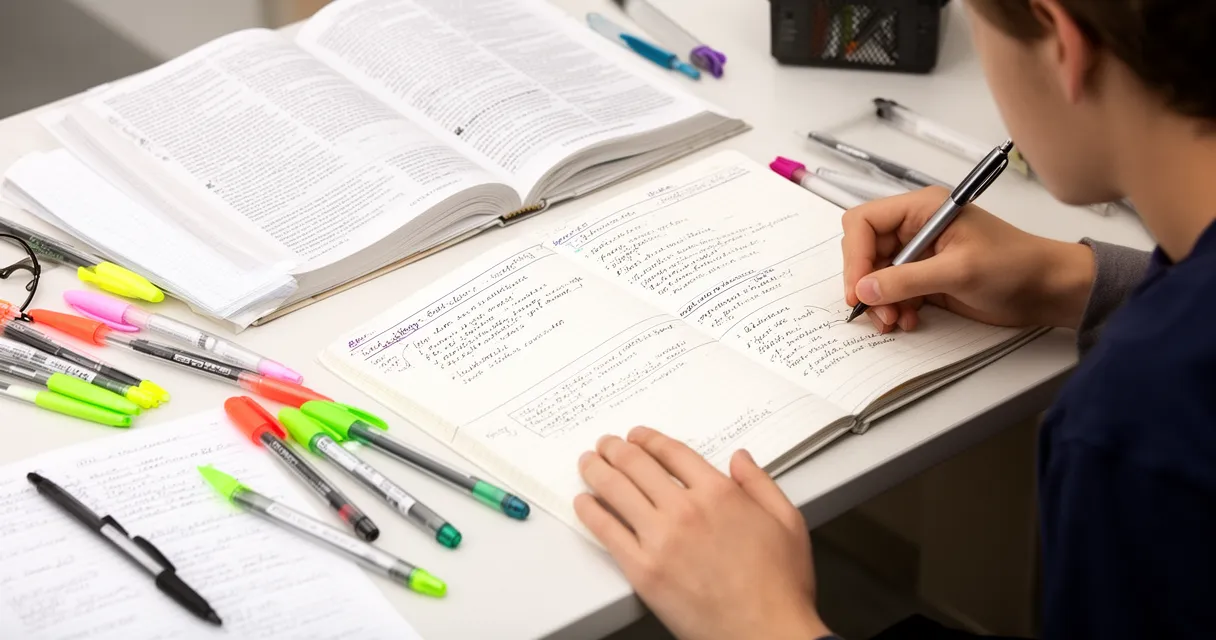
Annotate in the margins. After reading a paragraph, write a 5-word summary of its main point in your own words. This forces processing.
Highlight sparingly — and only after reading. The biggest highlighting mistake is marking text while you read. It creates a false sense of understanding without actual processing. Read the full paragraph first, then highlight only the single most important phrase.
Use a symbol system:
- ★ for key concepts
- ? for anything unclear
- → for connections to ideas from other sections or prior knowledge
Read difficult passages aloud. Vocalization slows you down and engages more of your brain, improving retention of complex or technical text.
How to Stay Focused and Avoid Zoning Out
Most attention drift happens because you have no purpose for reading. When your brain doesn’t know what it’s looking for, it disengages.
The fix is simple: set a question before every section. That question gives you a target, and targets keep you reading with intent.
Other focus strategies that work:
- 25-minute sessions with deliberate 5-minute breaks — your comprehension will be sharper when you return
- Read with a pen in hand — the physical engagement keeps your attention on the page
- Phone in another room — not on silent, but physically absent. Notifications, even ignored ones, fracture concentration
If you find yourself re-reading the same sentence three times, that’s a signal to take a break, not push harder.
How to Take Notes From a Textbook That Are Actually Useful
The most common note-taking mistake is transcription. Copying text word-for-word doesn’t require thinking — which means it doesn’t build memory.
Useful textbook notes follow these principles:
Use the Cornell Note method. Divide your page into three areas: a narrow left column for cue questions, a wide right column for your notes, and a summary box at the bottom. After reading, add your questions in the left column and fill the summary box in your own words.
Paraphrase every idea. If you can’t say it in your own words, you don’t understand it yet. The act of paraphrasing forces you to process, not just copy.
Capture these categories separately:
- Definitions of key terms
- Cause-and-effect relationships
- Specific examples the author gives
- Any concepts you don’t fully understand yet (mark with a ?)
Label everything. Date each note page and include the chapter and section number. You’ll thank yourself when you’re studying the night before an exam and can’t remember where a concept came from.
After You Read: Turn Textbook Notes Into Study Materials
Reading is not studying. This is one of the most important — and most counterintuitive — facts about learning.
Reading is input. Retrieval practice is how you actually build long-term memory. Flashcards, practice questions, self-quizzing, teaching a concept out loud — these are the activities that cement information. Reading alone, even active reading, is only the first step.
The critical window is within 24 hours of your reading session. The forgetting curve starts eroding new information immediately. Converting your notes into active-recall formats before that happens is what separates students who retain information from those who re-read the same chapter four times before an exam.
AI-powered tools are changing this step significantly. A 2025 Pearson analysis of nearly 80 million interactions from approximately 400,000 higher education students found that a single AI study tool interaction inside a digital textbook made a learner 3x more likely to be classified as an active reader (Pearson Learning Science Study, 2025, via PR Newswire).
Tools like AI flashcard generators — including integrations within platforms like Quizlet, Anki with AI plugins, and standalone AI study tools — can take your margin notes, highlighted terms, and question-answer pairs and convert them into ready-to-review flashcard decks in seconds. This eliminates the manual card-creation bottleneck that stops most students from ever completing the reading-to-studying loop.
You can also make flashcards directly from your textbook or use AI to turn your reading notes into flashcards automatically.
The Reading-to-Studying Workflow
Here’s the complete system, end to end:
- Preview — Scan headings, bolded terms, figures, and end-of-chapter questions (2–3 min)
- SQ3R Read — Survey → Question → Read → Recite → Review
- Annotate — Margin summaries, symbols, sparing highlights
- Recite — Close the book and reconstruct key points from memory after each section
- Convert — Transform notes and annotations into flashcards or a structured study guide (within 24 hours)
- Spaced Review — Review flashcards at increasing intervals: 1 day, 3 days, 1 week, 2 weeks
If you want to go further, learn how to condense your notes for studying or turn your reading notes into a full study guide with effective textbook reading strategies.
Try pasting your textbook notes into an AI study tool to generate a ready-to-review flashcard deck in seconds — no manual card creation required.
Frequently Asked Questions
What is the best method for reading a textbook for studying?
The SQ3R method — Survey, Question, Read, Recite, Review — is the most research-backed approach for textbook reading. The Recite step (closing the book and reconstructing key points from memory) is the most commonly skipped and the most important for retention. Don’t skip it.
How do you read a textbook without getting bored or losing focus?
Turn each heading into a question before you start reading that section. This creates a specific purpose and keeps your brain actively searching for an answer rather than drifting. Combine this with 25-minute focused sessions and a pen in your hand to stay engaged.
How long should you spend reading a textbook per session?
Use the 5-minutes-per-page rule to estimate total reading time, then break that into 25–45 minute focused blocks with 5-minute breaks. Comprehension drops sharply after 45–60 minutes of continuous reading — shorter, frequent sessions outperform marathon ones.
Does reading a textbook actually count as studying?
Passive reading alone does not constitute effective studying. Reading becomes studying only when paired with active recall — reciting, writing, quizzing, or flashcard review. Think of textbook reading as gathering raw material; retrieval practice is the actual studying.
What is the SQ3R method and how do you use it for textbooks?
SQ3R stands for Survey, Question, Read, Recite, Review. Developed by Francis Robinson in 1941 and supported by decades of educational research, it converts passive reading into an active retrieval exercise. See the full step-by-step walkthrough above for a worked example.
How can you convert what you read in a textbook into flashcards or a study guide?
After reading and annotating each chapter, collect your margin notes, highlighted key terms, and question-answer pairs. Feed them into an AI flashcard generator, or format them using the Cornell Note method into a structured study guide. Within 24 hours of reading is the optimal window before the forgetting curve takes hold.
Conclusion
Knowing how to read a textbook effectively is one of the highest-leverage skills you can build as a student — and unlike raw intelligence or motivation, it’s entirely learnable.
Active reading — questioning before you read, annotating as you go, reciting from memory after each section — retains dramatically more information than passive re-reading, and the research consistently backs this up.
But reading is only the first step. Converting your notes into flashcards or a structured study guide completes the learning loop and is what separates students who retain information from those who feel like they’ve studied but still can’t recall anything on exam day.
Ready to close the loop? After your next reading session, paste your notes into an AI study tool to generate a flashcard deck in seconds — and start your spaced-repetition review today. For more on building an efficient study workflow, explore our guide to effective study techniques.