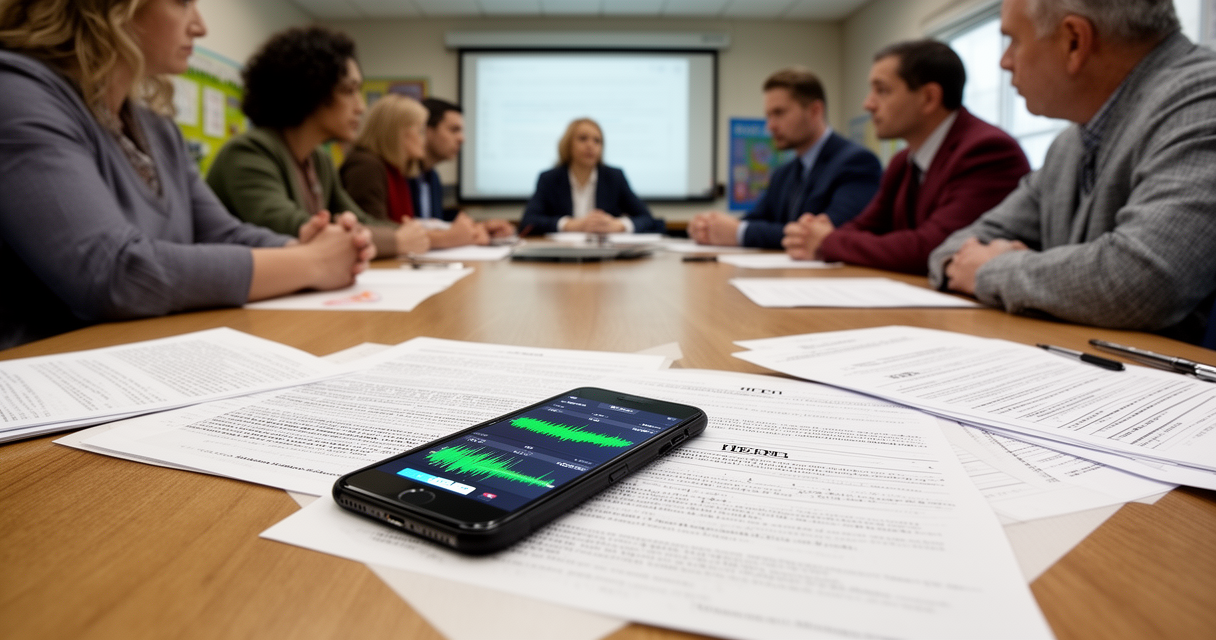
A parent walks into an IEP meeting, opens Otter.ai on their phone, and hits record before anyone says a word. Nobody in the room agreed to it — the case manager just watched it happen. That scene is repeating in special education offices nationwide, and school teams disagree sharply on whether it’s even safe to allow, let alone whether they can stop it.
The stakes go past etiquette. Otter.ai and Fireflies.ai, the two AI notetakers most likely to show up at an IEP table, are both currently defending active lawsuits over how they capture voice data. That changes the risk calculus for any district writing a policy — or any parent assuming the app is neutral.
The short answer: neither side automatically wins. IDEA’s parent-participation rule leans toward allowing recording tools, state consent law can override that depending on geography, and FERPA governs the district’s own use of these tools but not a parent’s. None of that has been tested against AI transcription specifically. What follows is where the law, the lawsuits, and the practitioner debate actually stand as of mid-2026.
AI Writing the IEP vs. AI Transcribing the Meeting — Not the Same Question
These get conflated constantly, and the confusion is doing real damage to the policy conversation. A tool that helps a case manager draft present levels of performance or IEP goals is a document-generation tool. It doesn’t capture anyone else’s voice, doesn’t require consent from the room, and its output is reviewed and signed by the team before it means anything. That category is covered in our full roundup of AI tools for special education teachers and in a dedicated look at AI IEP generators.
Otter.ai and Fireflies.ai are a different category entirely. They record and transcribe live conversation — every voice in the room, in real time, whether or not each speaker wants to be captured. That distinction is exactly why the legal questions below apply to notetakers and not to drafting assistants.
A teacher on r/Teachers described how thin the guardrails still are on the drafting side alone: “The state dept of education did a training for sped teachers and TOLD us to use AI on our IEPs. I refuse to do that. The kids didn’t/can’t consent to have their information in existence in the AI data pool.” If that’s the level of scrutiny document drafting is getting, live meeting transcription — capturing a parent’s and a child’s actual voice — deserves at least as much.
Can a District Legally Ban AI Notetakers From an IEP Meeting?
IDEA requires districts to ensure parents can meaningfully participate in IEP meetings, per 34 CFR § 300.322. The Office of Special Education Programs’ guidance (Appendix A to the Part B regulations) addresses recording directly, though not in the way most policies assume. Part B does not mention recording devices at all. States and districts may adopt their own policies restricting recording — but OSEP’s guidance says any such policy must include an exception where recording is necessary for a parent to understand the IEP process or exercise their procedural rights.
That guidance was written for audio and video recording generally. It predates consumer AI transcription tools by years. Extending it to cover Otter.ai and Fireflies.ai specifically is an inference special education advocates and practitioners are making — a reasonable one, but not something a court or OSEP has actually ruled on for AI notetakers as a category.
One special education professional summarized the practical read on r/specialed: “There’s nothing in the law that excludes recording or AI on behalf of the parent, so it’s generally allowed. Any restrictions or policies around it are determined locally… Removing tools for a parent to meaningfully participate in the conversation, such as AI, could be a violation.” That is a reasonable reading of the regulatory intent — not a guarantee that a blanket ban would lose in court, since no ruling on this exact question exists yet.
Districts already write narrow, tool-specific AI policies rather than outright bans in adjacent areas — the same logic schools apply to AI compliance and detection tools schools already use for classroom work. A parity policy is the more defensible middle ground: if a parent can use an AI notetaker, the district’s own team can use one too, under its own data agreement, rather than prohibiting the tool for one side of the table only.
Where the Otter.ai and Fireflies.ai Lawsuits Actually Stand (as of July 2026)
The Otter.ai case is the more advanced of the two. In re Otter.AI Privacy Litigation, No. 5:25-cv-06911 (N.D. Cal.), consolidates four suits filed between August and September 2025 into a single consolidated complaint filed December 5, 2025. Plaintiffs allege that Otter’s “OtterPilot” feature recorded and transcribed meeting participants — including people who never signed up for or agreed to use Otter — without their consent, in violation of the California Invasion of Privacy Act and the federal Wiretap Act. A motion-to-dismiss hearing was held May 20, 2026, before Judge Eumi K. Lee. No ruling had been issued as of the most recent reporting available.
Fireflies.ai is facing a separate legal theory. At least one Illinois federal class action, filed in December 2025, alleges the company’s “Speaker Recognition” feature collects voiceprints from meeting participants without the written consent BIPA requires. Related suits were reported in early 2026, though the exact count and filing details across jurisdictions weren’t consistently confirmed across sources. No ruling or dismissal has been found for that case either.
The distinction matters more than it looks. Otter’s suit is about recording and transcribing people without their knowledge — a consent-to-record problem. Fireflies’ suit is about biometric voiceprint collection — a consent-to-identify problem, tied specifically to the feature that tells a transcript who said what. That second capability, speaker identification, is exactly what makes a notetaker useful in a multi-person IEP meeting with a case manager, a special education teacher, a related service provider, and a parent all talking. It’s also the feature currently under a BIPA class action.
Plaintiffs in both cases are alleging unlawful conduct; neither company has been found liable, and both motions remain pending. This is not legal advice, and nothing here should substitute for a district’s or a family’s own attorney reviewing the specific facts.
Is Otter.ai Actually FERPA Compliant, or Is That Marketing?
FERPA governs schools, districts, and the vendors districts contract with, through the school-official exception at 34 CFR § 99.31(a)(1) — which requires a written agreement establishing the vendor’s obligations. FERPA does not bind a parent using a tool on their own to capture their own child’s meeting. There is also no such thing as a self-awardable “FERPA compliant” certification. FERPA is not a badge a company can earn and display; it’s a set of legal obligations that only attach through a signed data-sharing agreement with a district.
Otter.ai publishes standard enterprise security certifications — SOC 2 Type II and AES-256 encryption disclosures among them — but does not appear to make an explicit FERPA compliance claim on its public materials. That gap is worth sitting with rather than resolving in either direction: it doesn’t mean the tool is unsafe for schools, and it doesn’t mean it’s safe by default. It means the actual compliance burden sits entirely with whatever data-sharing agreement a district signs, not with anything the vendor markets.
A practitioner on r/specialed drew the line cleanly: “If security and privacy are the concern: FERPA binds the school, not the parent. A parent sharing their own child’s information with a tool of their choice isn’t a FERPA violation.” Another added the flip side of that same logic: “If the parent is creating the AI notes then FERPA isn’t something the district needs to manage. If the parent is recording, the district should be as well… I can’t imagine any due process procedures accepting AI notes over a recording.” That second point — official recordings carrying more evidentiary weight than an AI transcript — comes back later.
State Consent Law: The Part That Actually Controls Whether You Need Notice
This is the piece that actually determines whether a parent or a district needs to announce that Otter or Fireflies is running. Most states are one-party consent states, meaning only one person in the conversation needs to know it’s being recorded — which, practically, means anyone in the room can turn on a notetaker without asking.
About a dozen states require all-party consent, where everyone present has to agree before recording starts. California, Connecticut, Delaware, Florida, Illinois, Maryland, Massachusetts, Montana, New Hampshire, Oregon, Pennsylvania, and Washington are commonly cited examples — though the specifics vary by jurisdiction. Some states split the rule by context (phone calls versus in-person conversations), and Connecticut and Oregon carry their own carve-outs on top of that.
This list is illustrative, not a complete legal map, and consent statutes get amended. Anyone deciding whether an IEP meeting requires advance notice before an AI notetaker runs should confirm their specific state’s current statute — ideally with district counsel or a parent advocate familiar with the local rule, not a blog post.
Otter.ai vs. Fireflies.ai for This Specific Use Case
For general meeting notetaking, transcription accuracy, and integrations, see how Otter.ai, Fireflies, and other AI notetakers stack up generally. For the IEP-specific question, the more relevant difference is legal exposure, not feature depth.
Fireflies’ Speaker Recognition — the feature that labels each speaker by name across a transcript — is the exact capability under the Illinois BIPA suit. In an IEP meeting with four or five speakers, that labeling is genuinely useful: it’s the difference between a flat wall of text and a transcript that shows who agreed to what accommodation. It’s also the specific mechanism a court could eventually find requires written biometric consent under Illinois law, and potentially under similar statutes elsewhere.
Otter’s exposure runs through a different door — the wiretap and consent claims in the N.D. Cal. litigation, which target the recording and transcription of non-consenting participants generally, speaker labels or not. Switching from Otter to Fireflies, or the reverse, does not solve the underlying concern. Both companies are defending suits over how they capture and process voice data from people who didn’t necessarily agree to it; picking one over the other changes which legal theory applies, not whether one exists.
What Happens If the AI Transcript Is Wrong in a Due-Process Hearing
Special education meetings run on vocabulary that general-purpose transcription models were not trained to prioritize: “specially designed instruction,” “present levels,” specific accommodation language, disability-specific terminology. A practitioner on r/specialed put the risk plainly: “I have seen some AI note-taking apps make some serious errors especially when the topic includes a lot of very specific education language.” A transcription error in an IEP-specific term isn’t a typo — it can misstate what the team actually agreed to.
That matters most if a dispute later reaches due process. One frequently cited approach on r/specialed lays out language districts can adapt directly: “You might talk to your administrators about developing a statement to the effect that ‘AI note-taking is susceptible to transcription errors; as a result parents who wish to have a detailed record of conversation during the meeting should use a voice recording method. In the event of a discrepancy between an AI transcription and the official IEP documentation, the official IEP shall be considered the sole legal record.’ But parents are allowed to waive privacy restrictions and if they choose to feed their child’s private information to an app, there isn’t much you can do about it.”
The signed, written IEP document — not an AI transcript, and not even a raw audio recording — remains the controlling legal record in a dispute. Stating that plainly, in writing, before a meeting starts is a cheaper fix than litigating it after a disagreement over what someone said.
Our Take: A Policy Framework, Not a Ban
A reflexive ban on AI notetakers is the wrong move for most districts, and the OSEP guidance on parent participation is the reason why — even accounting for the fact that guidance was never written with AI specifically in mind. Prohibiting a tool a parent is using to understand their own child’s meeting sits uncomfortably close to restricting meaningful participation, which is the one thing IDEA is explicit about protecting.
That doesn’t mean vendor marketing deserves a pass either. Some administrators point to the pending lawsuits and documented transcription errors as reason enough to prohibit AI tools outright, and that instinct isn’t unreasonable — active litigation over consent and biometric data is a real signal, not noise. But the fix for that risk is a documented policy, not a ban that likely conflicts with the parent-participation regulation and does nothing to address the underlying legal questions anyway.
A workable framework has four pieces. First, don’t blanket-ban parent-side AI notetakers; a narrow, exception-based policy holds up better against OSEP’s guidance than an outright prohibition. Second, apply a parity rule — whatever recording standard applies to parents applies to the district’s own team, using its own vetted tool under its own data agreement. Third, put a discrepancy clause in writing before meetings, not after a dispute: the signed IEP is the sole official record, full stop. Fourth, treat any AI notetaker the district itself wants to adopt as a vendor requiring a signed FERPA agreement — the same standard already applied to other classroom AI tools — not as a free personal app that happens to be convenient. Districts building this out should start with your district’s AI use policy as the template to adapt.
Frequently Asked Questions
Can a parent legally record an IEP meeting without telling the school?
It depends entirely on the state’s consent law. In one-party consent states, yes — the parent’s own knowledge that they’re recording satisfies the law. In the roughly dozen all-party consent states, everyone in the room needs to agree first, which typically means the parent has to disclose it. IDEA’s parent-participation protections don’t override a state’s consent statute.
Does a district need separate consent to use its own AI notetaker in an IEP meeting?
State consent law still applies regardless of who’s running the tool. A district using Otter or Fireflies for its own notes in an all-party consent state needs everyone’s agreement, same as a parent would. FERPA also requires a written data-sharing agreement with the vendor before student information touches the tool.
Is a plain audio recording legally safer than an AI transcript?
In terms of evidentiary weight in a dispute, yes — a raw recording is generally treated as more reliable than an AI-generated transcript, since it isn’t subject to transcription error around specialized vocabulary. It doesn’t eliminate the consent-law question, but it removes the accuracy question that AI transcripts introduce.
Should teachers refuse to use AI notetakers for IEPs if they’re uncomfortable with it?
That’s a legitimate personal and professional position, and nothing in IDEA or FERPA requires a teacher personally to operate an AI tool. The more relevant constraint is whether the teacher, as part of the team, can restrict a parent’s own use of one — which the parent-participation regulation makes harder to justify than it might seem.
The Bottom Line
No court has ruled on whether Otter.ai’s or Fireflies.ai’s practices are unlawful, and no regulator has settled whether AI transcription counts as the kind of recording OSEP’s parent-participation guidance protects. What exists instead is a stack of partial answers: IDEA leans toward allowing it, FERPA only binds the district’s own use, state consent law is the actual gatekeeper on notice, and both leading tools are defending active suits over how they capture voice data.
The practical move for a district isn’t to wait for a ruling — it’s to write the four-point policy now: allow with narrow exceptions, apply the same rule to both sides of the table, put the discrepancy clause in writing, and vet any tool the district itself adopts as a vendor. That framework survives regardless of how the pending litigation resolves.
References
- In re Otter.AI Privacy Litigation, No. 5:25-cv-06911 (N.D. Cal.) — consolidated complaint filed Dec. 5, 2025; motion-to-dismiss hearing May 20, 2026 — https://natlawreview.com
- UC Today — Otter.ai lawsuit coverage — https://uctoday.com
- RecordingLaw.com — Otter.ai litigation overview and state-by-state consent law guide — https://recordinglaw.com
- Top Class Actions — Fireflies.ai BIPA voiceprint class action coverage — https://topclassactions.com
- 34 CFR § 300.322 — IDEA Part B, parent participation — https://www.ecfr.gov
- U.S. Dept. of Education, OSEP — IDEA Part B Regulations, Appendix A — https://sites.ed.gov
- 34 CFR § 99.31(a)(1) — FERPA school-official exception — https://www.ecfr.gov
- r/specialed — “AI note taking and IEP meeting legality question” — https://reddit.com/r/specialed/comments/1uuoz74/ai_note_taking_and_iep_meeting_legality_question/
- r/Teachers — “AI demands” — https://reddit.com/r/Teachers/comments/1r7o19d/ai_demands/
- Otter.ai Trust & Security page — SOC 2 Type II and AES-256 disclosures; no explicit FERPA claim identified