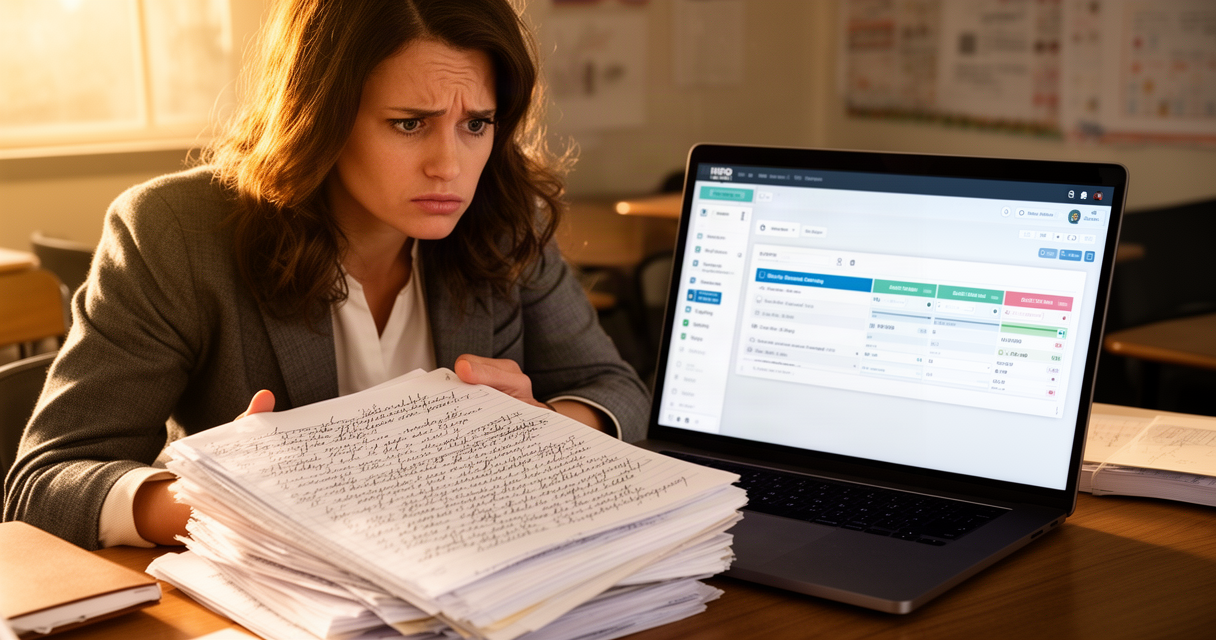
A teacher drafting 28 report card comments at 10 p.m. pastes a student’s full name, grade average, and a note about “frequent behavioral disruptions” into ChatGPT to speed things up. Is that a FERPA violation? Probably not in the legal sense anyone gets fined for. Is it a genuinely avoidable risk with a student’s identifiable record? Yes.
That distinction is the whole story with AI report card comment generators, and it gets flattened by both sides of the argument. The quick answer: plain consumer ChatGPT trains on what gets typed into it by default unless a teacher manually turns that off, so feeding it a full name plus grades or behavior notes is a real, unforced risk. Khanmigo and MagicSchool AI, by contrast, have signed data privacy agreements with districts and documented no-training commitments. Smaller free “report card comment generator” tools scattered around the app stores mostly publish nothing verifiable at all. And “FERPA compliant,” printed on a landing page, is a marketing claim — not a certification anyone checked.
The rest of this piece breaks down what actually separates those categories, tool by tool.
What FERPA and a DPA Actually Require for AI Report Card Comment Generators (Not the Marketing Version)
FERPA protects “education records” — grades, disciplinary notes, IEP details, attendance, anything tied to an identifiable student. A report card comment built from a student’s name and performance data qualifies. The law allows schools to share those records with a “school official” who has a legitimate educational interest, and a vendor can sometimes qualify as a school official — but only if the district has a contract establishing that relationship, direct control over the data, and use restrictions. That contract is the data privacy agreement, or DPA.
A DPA is the actual mechanism that makes an AI tool usable with student data under FERPA. A homepage badge that says “FERPA compliant” is not. Nobody audits that badge. Any vendor can print it.
This is where the specifics matter. OpenAI’s own terms lay out different rules by tier: ChatGPT Free and Plus train on conversation data by default, with an opt-out available under Settings > Data Controls. ChatGPT Team, Enterprise, and API access do not train on inputs by default. A teacher using a personal ChatGPT Plus account for report cards is, by default, feeding student information into a training pipeline — unless they’ve found and flipped that toggle.
Teachers on r/Teachers have flagged exactly this gap: “Not to mention it may be breaking confidentiality laws/FERPA to feed identifiable student data to it.” Another put the structural problem more bluntly: “When we willy nilly just introduce AI platforms into our classrooms, we do so with unregulated AI systems that have no formal contracts and structures for student privacy.”
Here’s the part that gets less attention: plenty of districts that banned ChatGPT outright haven’t read a DPA either. Blocking the domain on the school network while approving zero vetted alternatives isn’t a privacy policy — it’s security theater that shifts the actual risk onto individual teachers, who then do the exact same thing on their personal phones and home Wi-Fi, just without anyone knowing.
Does Anonymizing (First Name Only) Actually Fix the FERPA Problem for AI Report Card Comment Generators?
Stripping the last name is a reasonable habit. It is not a compliance strategy, and treating it as one is where a lot of well-intentioned teachers go wrong.
A comment that reads “Emma has struggled to stay on task during small-group reading, particularly after her recent IEP meeting about processing speed” is still identifiable in a class of 22, first name or not. Combine a first name with a grade level, a specific accommodation, and a behavioral pattern, and re-identification takes about ten seconds for anyone who knows the roster — which, in a school building, is basically everyone with access to the system.
Mitigation is not the same thing as protection. Anonymizing helps at the margins. It does nothing once the comment includes grades, a specific incident, or context that narrows the field to one kid in a small class.
One teacher on r/Teachers framed the underlying discomfort well: “I have a big problem with the teachers who run student work through AI for grading, or will put in identifying information about the student to email parents or for reporting comments. AI and privacy is a land mine we don’t totally know yet.” That is where things actually stand — not settled, not resolved by a first-name workaround, and worth taking seriously precisely because the legal terrain is still shifting.
The sharper point: pasting a full behavior write-up into consumer ChatGPT is a real, avoidable risk for zero actual benefit, given that free, purpose-built alternatives with signed DPAs already exist. There’s no upside trade being made here. It’s just habit and convenience outrunning the better option that’s sitting right there.
AI Report Card Comment Generators Compared: Who Actually Has a DPA vs. Who Just Says “FERPA Compliant”
Some tools in this category have documentation a district’s legal counsel can actually verify. Most have a sentence on a marketing page and nothing behind it.
| Tool | Privacy Claim | Verification Status |
|---|---|---|
| Khanmigo (Khan Academy) | District DPAs signed; Chief Learning Officer has publicly stated no student or teacher data trains the underlying model; OpenAI is contractually barred from training on Khanmigo data | VERIFIED |
| MagicSchool AI | FERPA/COPPA/SOC 2-aligned; customizable DPAs including NY Ed Law 2-d; OpenAI and Anthropic both certify Zero Data Retention with signed attestations; holds the Common Sense Privacy Seal | VERIFIED |
| Monsha | Claims FERPA/COPPA/GDPR alignment, signed DPAs, SOC 2 Type II; designed to avoid requiring identifiable data | Verify directly with vendor |
| Orba | Claims student names are processed only for comment generation, never stored, shared, or used for training | Vendor self-report, unverified |
| EasyClass | No clear FERPA/DPA documentation found; runs on third-party servers | Same blind spot as plain ChatGPT |
| TeacherComments.app | Markets data as “encrypted and never shared”; no DPA or SOC 2 documentation found | Unverifiable |
| ReportCardWizard / Colleague.ai | No independently verifiable DPA documentation found (Colleague.ai’s own blog is the source recommending itself) | Unverifiable |
| Plain ChatGPT (no district agreement) | Trains on inputs by default (Free/Plus tiers); retains data up to 30 days for safety review | No FERPA protection |
The gap between row two and row six is the entire article. Khanmigo and MagicSchool have public, checkable statements from named executives and independent certifying parties (OpenAI, Anthropic, Common Sense Media). Everyone below that has either a self-report with nothing behind it, or nothing at all.
One caution worth keeping even for the verified tools: a teacher on r/Teachers put it well — “MagicSchool AI does have some good tools that can save time. BUT ALWAYS CHECK AI’S WORK.” A signed DPA covers where the data goes. It says nothing about whether the drafted comment is accurate, appropriately worded, or something a teacher should actually send home unedited. Those are separate problems, and both need solving — see our full MagicSchool AI vs Khanmigo comparison and our roundup of the best AI grading tools for teachers for the quality-control side of this.
Both Sides Are Being Dumb About This
District IT departments that ban ChatGPT on the network and call it a day are doing security theater, not privacy protection. Blocking one domain does nothing when the same teacher opens the same tool on a personal phone that evening, with the same student data, on a network nobody’s monitoring. A ban without an approved alternative doesn’t reduce the risk. It just moves it somewhere invisible.
Teachers pasting full IEP details or behavioral write-ups into a personal ChatGPT account, meanwhile, are taking on personal liability that isn’t theirs to carry. It’s an understandable habit born of exhaustion and a genuinely useful tool with no vetted district-approved version in sight. It’s still a bad habit.
The actual fix isn’t a ban and isn’t a free-for-all. It’s teachers understanding what a DPA is and isn’t, and pushing districts to sign one instead of pretending the problem goes away by blocking a URL.
One thing worth debunking directly: a “$10,000 per violation” figure circulates in some of these discussions as the personal risk a teacher is supposedly taking on, framed against “$0 for the vendor.” That number is marketing FUD, not FERPA. FERPA’s actual enforcement mechanism is the loss of federal funding to the institution — the school or district — not a per-incident fine against an individual teacher. That doesn’t mean the risk is zero. It means the risk is institutional and reputational, not a personal invoice showing up in the mail. Scaring teachers with a made-up dollar figure doesn’t make anyone more careful; it just makes the whole conversation easier to dismiss as hype.
A teacher on r/Teachers described what the better version of this looks like in practice: “Hopefully they are using a district paid for AI program that maintains confidentiality. Our district does for IEPs.” That’s the target state — not a ban, not a free-for-all, a signed agreement that someone with legal authority actually reviewed. The same gap shows up with other classroom AI tools: the same FERPA questions came up with Otter.ai in IEP meetings, and it applies equally to AI tools for parent communication carrying similar data-sharing questions.
What to Do If Your District Hasn’t Approved Any AI Tool
The first move is a direct question to IT or the district office: is there a DPA signed with any AI vendor, for any purpose? Many districts already have one in place for IEP software, a monitoring platform, or a learning management system, and nobody has bothered to tell classroom teachers it exists or extends to a comment-writing tool.
If the honest answer is no — no DPA, no approved tool — the interim workaround looks like this:
- First name only, no last name, no student ID number.
- Strip specific identifying details — exact incident dates, IEP accommodation names, anything that narrows the field to one student in a small class.
- Keep prompts generic. “Write a supportive comment about a student who is strong in class discussion but needs to build independent work habits” carries none of the risk that a name-and-incident version does.
- Turn off the ChatGPT training toggle under Settings > Data Controls if using a personal account at all.
- Push the district toward Khanmigo or MagicSchool specifically — the two tools in this category with verifiable, documented no-training commitments, not just a claim on a page.
The same vetting logic districts already apply to monitoring software should apply here. Most have some process for it — see how districts vet monitoring tools like GoGuardian, Securly, and Gaggle for what that process typically looks like when it’s done properly. Report card tools deserve the same scrutiny, not less.
Frequently Asked Questions
Is typing a student’s name into ChatGPT for a report card comment a FERPA violation?
It’s a real risk, not an automatic violation. FERPA violations are enforced against institutions through federal funding, not against individual teachers through fines. But feeding identifiable data into a consumer tool that trains on inputs by default, with no district DPA covering it, is exactly the kind of unauthorized disclosure FERPA exists to prevent.
Which AI report-card tools have an actual signed district DPA vs just “FERPA compliant” marketing?
Khanmigo and MagicSchool AI both have documented, verifiable DPAs and independently certified no-training or Zero Data Retention commitments. Monsha and Orba make similar claims but rely on vendor self-reporting without third-party verification found. Smaller tools like EasyClass, TeacherComments.app, and ReportCardWizard have no clear DPA documentation at all.
Does anonymizing (first name only, no ID) actually solve the FERPA problem?
No. It reduces risk at the margins but doesn’t eliminate it — grades, behavioral details, or class size can still make a student identifiable even without a last name. Treat it as a partial mitigation, not a compliance strategy.
Do free tools like Khanmigo or EasyClass store or train on the data you enter?
Khanmigo does not: Khan Academy’s Chief Learning Officer has stated publicly that no student or teacher data trains the model, and OpenAI is contractually barred from training on Khanmigo data. EasyClass has no equivalent public documentation, which puts it in the same unverified category as plain consumer ChatGPT.
What should a teacher do if their district hasn’t approved ANY AI tool?
Ask IT directly whether any signed DPA exists for any AI vendor. If none does, stick to first-name-only prompts with identifying details stripped out, disable the ChatGPT training toggle if using a personal account, and advocate for the district to adopt Khanmigo or MagicSchool specifically, since both have documentation that actually holds up.
The Real Compliance Question Isn’t the Tool — It’s the Paperwork Behind It
There’s no version of this where every AI report card generator is either perfectly safe or uniformly dangerous. Khanmigo and MagicSchool have done the legal work and can show it. Most of the smaller free tools haven’t, and their marketing copy is doing the job a DPA is supposed to do. Plain consumer ChatGPT sits in the worst spot of all — genuinely useful, genuinely popular with teachers, and by default training on exactly the kind of identifiable student data it shouldn’t be trained on.
The safe workflow was never about avoiding AI in the classroom. It’s about knowing the difference between a tool with a real DPA and one that just says the right words on its homepage.