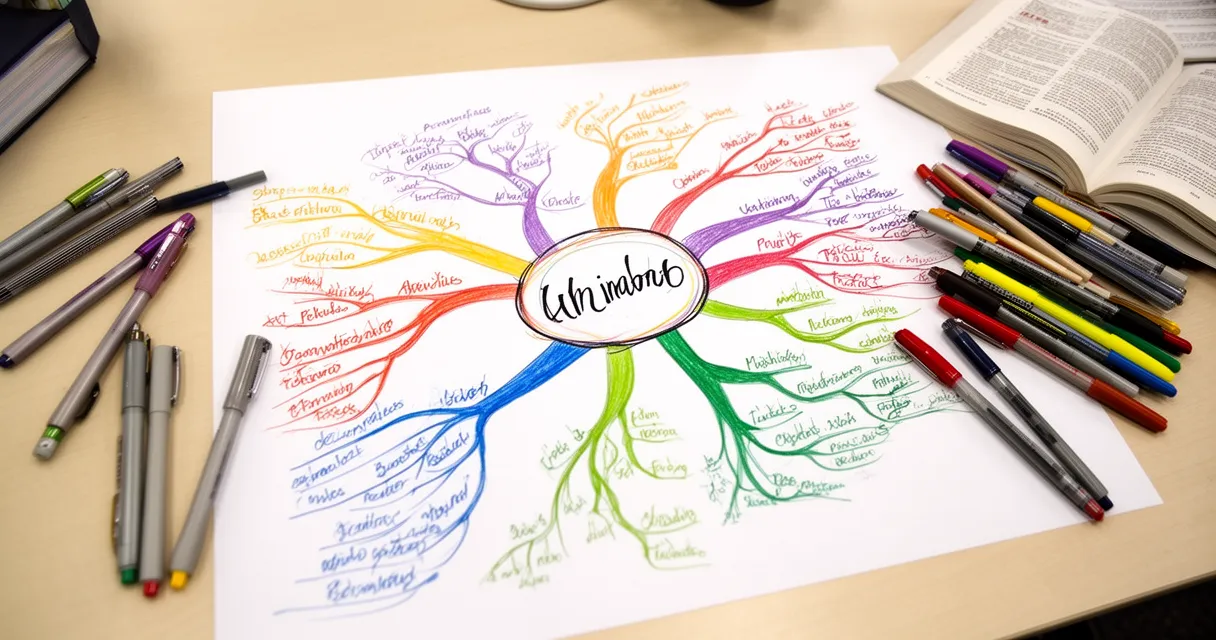
Your notes are full of information — but when exam day arrives, it all blurs together.
You’ve highlighted every paragraph. You’ve re-read the chapter twice. But the ideas still feel like a pile of disconnected facts rather than a topic you actually understand. That’s not a focus problem. It’s a format problem.
Linear notes capture facts but don’t show how ideas connect. That makes it hard to see the big picture or recall information under pressure.
In this guide, you’ll learn exactly how to make a mind map for studying: what it is, how to build one from scratch for any subject, and how to use it to actually retain what you’ve mapped.
Quick answer: Write your main topic in the center of a blank page, draw branches for each key subtopic, and add keywords or short phrases to each branch. Use color coding and simple visuals to strengthen memory connections, then review the completed map regularly before your exam. Keep reading for the full step-by-step process, a worked example, and what to do with the map once it’s built.
What Is a Mind Map (and Why Does It Work for Studying)?
A mind map is a radial diagram with one central concept at the center and related subtopics branching outward like spokes on a wheel. Each branch can split into smaller sub-branches of supporting detail.
This structure mirrors how the brain naturally stores and retrieves information — in networks of associations, not straight lines. A mind map reflects that structure, which is why the mind map study technique consistently outperforms passive re-reading.
The research backs this up:
- Students who use mind mapping can boost their grades by 12%, according to research cited by Johns Hopkins University, attributed to how mind mapping helps students organize and understand concepts more deeply. (Source: Johns Hopkins University / llcbuddy.com Mind Mapping Statistics 2025)
- Mind mapping can improve information retention by 10–15% and make learning up to 15% more efficient compared to traditional study techniques. (Source: electroiq.com Mind Mapping Statistics 2025)
Mind mapping works best for subjects built around connected concepts — biology, history, literature, law, psychology. It’s less suited to sequential subjects like calculus, where procedural practice matters more than conceptual mapping.
What You’ll Need Before You Start
You don’t need much. Gather these before your first session:
- Your source material: notes, a textbook chapter, or lecture slides on a single topic
- A blank page: A4 or A3 paper — bigger is better when starting out
- Colored pens or highlighters: At least 3–4 colors
- 5–10 minutes of prep time: Skim your material and identify the main topic and 4–6 top-level subtopics
A quick scan before drawing prevents you from getting stuck midway. Think of it as a 5-minute outline you’re about to make visual.
Tip: Paper is recommended for beginners — the physical act of drawing and writing by hand strengthens memory encoding. Once comfortable with the process, digital tools like Miro, MindMeister, or Coggle offer easy editing and sharing.
How to Make a Mind Map for Studying: Step-by-Step
Here is the complete six-step process for how to make a mind map for studying any subject.
Step 1: Write Your Central Topic
Place the topic name at the center of your blank page. Keep it short — 2–4 words maximum. Draw a circle or box around it.
Examples: “The French Revolution” · “Cell Division” · “Supply and Demand”
If your topic feels too broad, narrow it to a single chapter, unit, or concept.
Step 2: Identify Your Main Branches (Level 1)
These are the major subtopics or categories under your central topic. For a history chapter: Causes, Key Events, Key Figures, Consequences. For a biology chapter: Mitosis Stages, Meiosis Stages, Cell Cycle, Key Terms.
Aim for 4–6 main branches. Draw thick, curved lines radiating outward from the central circle — one per branch.
Step 3: Add Sub-Branches (Level 2 and 3)
Break each main branch into supporting details, dates, names, examples, or definitions. Use keywords only — not full sentences. Write “1789 Storming of Bastille,” not a full explanation.
Short phrases force your brain to encode meaning rather than copy text. That’s the core of how to create a mind map for notes you’ll actually remember. Draw thinner lines for deeper levels to show hierarchy at a glance.
Step 4: Use Color Coding
Assign one color to each main branch and use it consistently for all sub-branches beneath it. Color acts as a visual retrieval cue — when recalling information later, the color grouping helps your brain locate and cluster related facts faster than a monochrome page ever could.
Step 5: Add Icons, Symbols, or Small Sketches
Even simple visuals improve recall. Try:
- A star next to facts likely to appear on the exam
- A question mark next to concepts you need to revisit
- A small sketch next to a biology definition or historical event
These visuals engage your brain’s picture-memory system alongside language memory, making the map more scannable. This is one of the most underrated parts of any visual study method.
Step 6: Review and Refine
After your first draft, ask:
- Is any branch too crowded? More than 6–7 items? Split it into two branches.
- Are there connections between branches? Draw a dashed line across the map to link related ideas. These cross-links are where real understanding lives.
- Is anything missing? Check your source material against the map and fill gaps.
Refinement takes 5 minutes but dramatically improves how usable the finished map is.
Worked Example: Mind Map for a History Chapter
Let’s apply this to “Causes of World War I” as the central topic.
Main branches: Nationalism · Imperialism · Militarism · Alliance Systems · The Assassination
Sub-branches for “Alliance Systems”:
- Triple Alliance: Germany, Austria-Hungary, Italy
- Triple Entente: France, Russia, Britain
- Triggered chain reaction after assassination
- Austria-Hungary declared war → others pulled in
What this shows that linear notes don’t:
By mapping it, you can see at a glance that the assassination was the trigger but that the alliance system was the mechanism that turned a regional dispute into a world war. That relationship is invisible in bullet-point notes — it becomes obvious on a map.
A dashed cross-link connecting “Militarism” and “Alliance Systems” would show how an arms race made those alliances more volatile. That’s the kind of analytical connection that earns marks in an essay, and it emerges from the visual format naturally.
Mind Mapping vs. Other Study Techniques: When to Use Each
One of the most common questions about mind mapping for students is how it compares to other methods.
| Study Method | Best For | Weakness |
|---|---|---|
| Mind Map | Concept-heavy topics, understanding relationships | Less effective for procedural learning |
| Linear Notes | Capturing information in real time | Doesn’t show connections between ideas |
| Outline | Organizing hierarchical information | Still linear; no cross-links |
| Flashcards | Active recall, memorizing facts/definitions | Lacks contextual overview |
| Practice Problems | Math, coding, physics application | Doesn’t build conceptual understanding |
These methods complement each other. A 2025 systematic review in Advances in Health Sciences Education (Springer Nature) found that mind maps and concept maps significantly enhance academic performance among undergraduates compared to traditional methods — with the strongest outcomes when combined with active retrieval practice.
In practice: use linear notes during a lecture, then convert them to a mind map afterward to consolidate and connect the material. This is one of the most effective combinations in your toolkit of effective study techniques.
The mind map vs flashcards for studying debate has a clear answer: don’t choose. Build the map to understand the topic, then use flashcards to drill recall on individual facts. The map gives you context; the cards force retrieval.
What to Do After You Build Your Mind Map
Building the map is step one. Using it is where the real learning happens.
Four high-impact ways to study with your finished map:
- Cover branches and recall from memory. Fold the page or put your hand over a branch and reproduce it on a scrap of paper. This applies active recall techniques directly to your visual map — one of the highest-impact study behaviors you can develop.
- Identify your weak branches. Which sections can’t you reconstruct? Those are your study priorities. Revisit only those sections instead of re-reading everything.
- Turn branches into flashcards. Each sub-branch is a natural flashcard prompt. Turn your mind map branches into flashcards for spaced repetition practice, combining visual understanding with active retrieval.
- Redraw the map from scratch 24–48 hours later. Don’t look at the original. Reproduce what you remember, then compare. Gaps reveal exactly what hasn’t been consolidated into long-term memory yet.
AI can accelerate this step. Tools like ChatGPT or Claude can take your branch keywords as input and generate quiz questions, fill-in-the-blank prompts, or a structured study guide in seconds. Paste in your sub-branches and ask: “Turn these into 10 exam-style questions.” Pair that output with your mind map’s visual overview and you have a study system that covers both understanding and retrieval.
Once your mind map is built, try converting your branches into a structured study guide or flashcard set to lock in what you’ve learned.
Best Subjects for Mind Mapping (and When to Skip It)
The mind map study technique isn’t a universal fix. Knowing when to use it saves time.
Works best for:
- Biology, History, Literature, Law, Psychology
- Language learning (vocabulary networks, grammar concepts)
Works less well for:
- Math and calculus (procedural practice matters more)
- Physics problem sets and programming syntax
- Chemistry stoichiometry (sequential calculations need sequential practice)
The rule of thumb: Use mind maps for the understanding phase of studying. Once you have conceptual clarity, switch to practice problems and active recall for the application phase.
If your notes feel overwhelming and you can’t see how ideas fit together, a mind map is almost always the right tool to reach for first. You can even condense your notes into a map after taking them linearly — the conversion itself counts as active studying.
Frequently Asked Questions
What is a mind map and how does it help with studying?
A mind map is a visual diagram that places your main topic at the center with related subtopics branching outward. It helps studying by showing how ideas connect, which mirrors how the brain stores memories — making information easier to understand and recall than linear notes.
How do you make a mind map step by step for a subject or chapter?
Write the main topic in the center, draw branches for each major subtopic, add keywords and details as sub-branches, color code by branch, add simple visuals, then review and refine. The full six-step process is covered above.
Are mind maps more effective than traditional note-taking for exams?
Research suggests mind mapping can improve retention by 10–15% compared to traditional notes for concept-heavy subjects. The two work best together: take linear notes during a lecture, then convert them into a mind map to consolidate the information.
What subjects or topics are mind maps best suited for?
Mind maps excel for subjects with interconnected concepts: biology, history, literature, law, psychology, and language vocabulary. They are less suited to sequential subjects like calculus or programming, where practice problems are more effective.
Can mind maps be used together with flashcards or active recall techniques?
Yes — and this combination is highly effective. Build the map first to understand the big picture, then convert each branch into flashcards for active recall practice. The map gives you context; the flashcards force retrieval. Together they cover both comprehension and memorization.
Conclusion
A mind map turns overwhelming notes into a visual overview that shows how ideas connect — and that shift from passive re-reading to active organization is where real learning happens. Once you learn how to make a mind map for studying, you have a repeatable system that works for any concept-heavy subject.
Key takeaways:
- The 6-step process (central topic → branches → sub-branches → color → visuals → review) works for any concept-heavy subject
- Mind maps are most powerful combined with active recall — build the map to understand, use retrieval practice to remember
- Use AI tools like ChatGPT or Claude to speed up your setup and generate review materials from your finished branches
- Know when mind maps are the right tool — and when to switch to practice problems for the application phase
Start with one chapter or one lecture topic today. Spend 10 minutes building your first mind map and compare how well you recall the material the next day versus your standard notes. One experiment is worth more than any study tip.