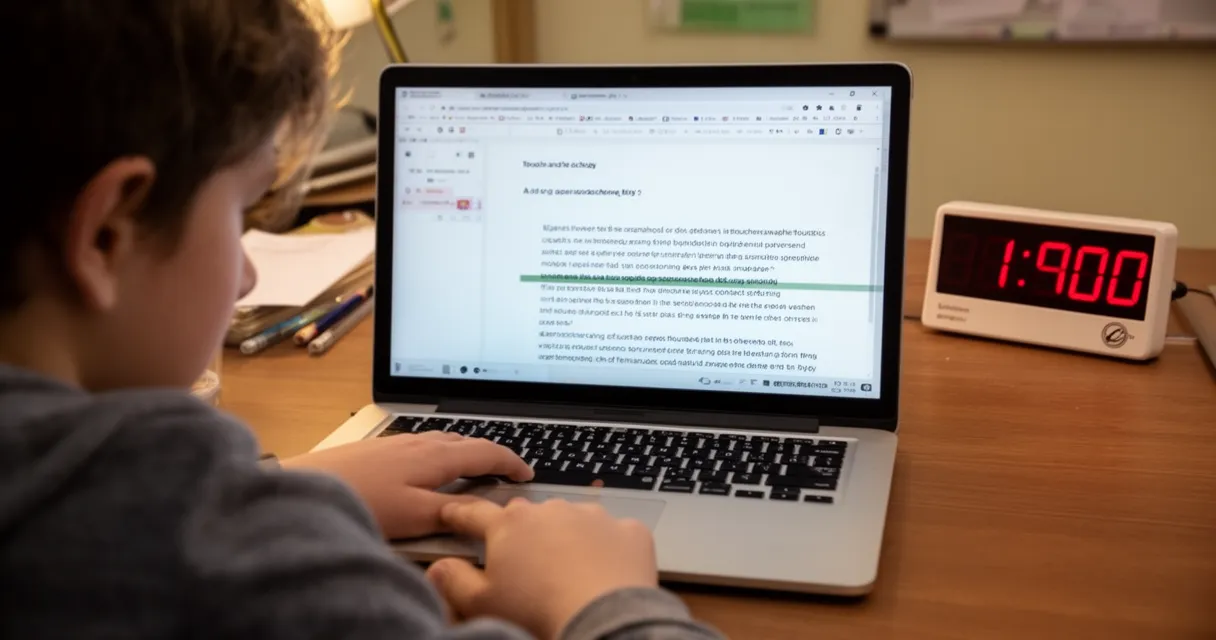
It’s 11 PM, your essay is due at 8 AM, and you’re staring at a blank document — sound familiar?
You’re not alone. Most students waste precious time before writing a single sentence. They agonize over the outline, second-guess the thesis, or freeze under pressure — not because they lack ideas, but because they lack a system.
Here’s the good news: you can learn exactly how to write an essay faster using a battle-tested process. From building a lightning-quick outline to drafting without distractions, this guide gives you a step-by-step playbook you can use tonight.
Quick answer: Spend 10 minutes outlining, write body paragraphs first, avoid editing while drafting, and work in focused 25-minute sprints. A focused student can produce a solid 1,000-word essay in under 90 minutes.
Why Students Waste Time Before Writing a Single Word
Let’s be honest — the biggest time-killer isn’t the writing itself. It’s everything that happens before the writing.
Research shows that roughly 50% of college students procrastinate chronically on writing tasks (Solving Procrastination). Among high school students, the number is even worse: 86% delay assignments until the last possible moment.
So what causes the delay?
- The blank-page bottleneck. Opening an empty document is psychologically paralyzing. Without a clear starting point, your brain treats the task as impossibly large.
- Fear of imperfection. Many students believe the first draft needs to be polished. It doesn’t. A rough draft exists to be rough.
- Decision overload. Choosing a thesis, picking sources, deciding structure — too many micro-decisions at once stalls momentum.
The fix? Remove decisions from the equation by following a repeatable system. That’s what the rest of this guide delivers. If you’d like to sharpen your overall approach to academics, start with these effective study techniques.
Step 1: Build Your Essay Outline in Under 10 Minutes
The single fastest way to learn how to outline an essay fast is to stop treating the outline like a mini-essay. An outline is a skeleton — bare bones only.
Set a timer for 10 minutes. Seriously. Having a hard deadline for the outline prevents you from overthinking it.
How to Write a Fast Thesis Statement
Your thesis doesn’t have to be Shakespeare. Use the Position + Reason formula:
[Topic] is [your position] because [reason 1], [reason 2], and [reason 3].
Example: “Remote learning is less effective than in-person classes because it reduces engagement, limits collaboration, and increases procrastination.”
That took 15 seconds. It’s clear, arguable, and gives you three body paragraphs automatically.
Pro tip: AI tools like ChatGPT or Claude can brainstorm thesis variations in seconds. Feed the tool your prompt and ask for three thesis options — then pick the strongest one and move on. For more on this, learn how to use AI tools to accelerate your workflow.
The 3-Point Outline Formula
Once you have your thesis, your outline practically writes itself:
- Body Paragraph 1: Reason/point #1 from your thesis + one supporting detail or example
- Body Paragraph 2: Reason/point #2 + one supporting detail or example
- Body Paragraph 3: Reason/point #3 + one supporting detail or example
That’s it. Write each point as a single bullet. Don’t write full sentences — just keywords and phrases. You now have a roadmap, and the blank-page problem is gone.
For longer essays (2,000+ words), simply expand each body paragraph into two or three sub-points. The structure scales.
Step 2: Write the Body First, Introduction Last
This is the essay writing tip for students that changes everything: skip the introduction.
Most students spend 30+ minutes crafting the perfect opening paragraph before they’ve written a single argument. That’s backwards. Here’s why writing the body first is faster:
- Your arguments shape your intro. You can’t summarize what you haven’t written yet. Writing the body first gives you clarity on what the essay is actually about.
- Body paragraphs are easier to start. Each one follows a simple pattern: topic sentence, evidence, explanation. It’s mechanical — and mechanical is fast.
- Momentum builds. Once you’ve finished three body paragraphs, writing the intro and conclusion feels like a victory lap, not a mountain climb.
Write each body paragraph in order of your outline. Start each one with a clear topic sentence that directly supports your thesis. Then add one or two pieces of evidence and a brief explanation. Move on.
Step 3: Draft Without Stopping — No Editing Mid-Flow
This is where most students sabotage their own speed. They write a sentence, re-read it, delete half of it, rewrite it, check grammar, and then wonder why the essay is taking four hours.
Stop editing while you draft.
The drafting phase and the editing phase use different parts of your brain. When you switch between them constantly, you lose momentum and burn mental energy on context-switching.
Here are the rules for a no-edit first draft:
- Don’t fix typos. You’ll catch them later.
- Don’t rewrite sentences. If a sentence feels clunky, highlight it in yellow and keep going.
- Don’t re-read previous paragraphs. Trust your outline and move forward.
- Don’t look up that one perfect word. Use a placeholder like “[WORD]” and find it during editing.
Your only job during drafting is to get words on the page. Quality comes later. Speed comes now.
This method is sometimes called “vomit drafting” — and it works. Students who separate drafting from editing consistently finish essays faster because they eliminate the start-stop cycle that devours time.
Step 4: Use the Pomodoro Technique to Write in Focused Sprints
If you’ve never heard of the Pomodoro technique, here’s the short version: work for 25 minutes, then take a 5-minute break. Repeat.
Why does this help you write an essay quickly?
- 25 minutes feels manageable. You’re not committing to hours of work — just one short sprint.
- Time pressure boosts output. Knowing the timer is running keeps you focused and prevents wandering.
- Breaks prevent burnout. A 5-minute walk or stretch resets your focus for the next round.
Here’s a realistic breakdown for a 1,000-word essay:
| Sprint | Task | Output |
|---|---|---|
| Sprint 1 (25 min) | Outline + thesis + body paragraph 1 | ~300-400 words |
| Sprint 2 (25 min) | Body paragraphs 2 and 3 | ~300-400 words |
| Sprint 3 (25 min) | Introduction + conclusion + quick edit | ~300 words + polish |
Total time: roughly 75-90 minutes for a polished 1,000-word essay. That’s three Pomodoro sprints with two short breaks in between.
The key is writing 300-400 words per sprint. That’s about one solid paragraph every 8-10 minutes — completely doable if you follow the no-edit drafting rule from Step 3.
Step 5: Eliminate Distractions for the Duration
You already know this, but knowing and doing are different things. Let’s make it concrete.
For the next 90 minutes, your phone does not exist.
Here’s the distraction-elimination checklist:
- Phone: Put it in another room. Not on silent — in another room. Studies show that simply having your phone visible reduces cognitive performance, even when it’s off.
- Browser tabs: Close everything except your document and one research tab. No email. No social media. No “quick checks.”
- Apps: Use a website blocker like Cold Turkey or Freedom to lock yourself out of distracting sites. Set the timer to match your writing session.
- Notifications: Turn off desktop notifications for Slack, Discord, and messaging apps. Every notification is a 10-minute detour disguised as a 5-second glance.
- Environment: If you can’t focus at home, go to a library. A change of scenery signals your brain that it’s time to work.
These aren’t suggestions — they’re requirements if you want to learn how to write a last minute essay without losing your mind. The fastest writers aren’t faster typists; they’re more focused ones.
If you want a full system for managing study sessions effectively, check out how to condense your notes to save even more time before writing.
How AI Tools Help You Write an Essay Faster
AI is a legitimate part of the modern student’s toolkit — when used correctly. A 2025 study published in Scientific Reports found that students who used AI for mechanical tasks redirected their effort toward critical thinking, producing higher-quality work in less time.
Here’s where AI genuinely accelerates the essay-writing process:
- Brainstorming thesis options. Give an AI tool your essay prompt and ask for three potential thesis statements. Pick one and refine it.
- Generating outline structures. AI can suggest logical flows for your argument in seconds.
- Paraphrasing awkward sentences. Paste a clunky sentence and ask for three clearer alternatives.
- Finding counterarguments. Ask AI what the strongest objection to your thesis is — then address it in your essay.
- Proofreading and grammar. Tools like Grammarly or ChatGPT can catch errors faster than manual review.
What AI Should (and Shouldn’t) Do for Your Essay
AI should:
- Help you brainstorm and organize ideas
- Suggest improvements to your existing writing
- Speed up research by summarizing sources
- Catch grammar and spelling errors
AI should NOT:
- Write your essay for you (this is plagiarism at most institutions)
- Replace your own critical thinking and analysis
- Be your only source of information (AI can hallucinate facts)
- Submit content that you haven’t personally reviewed and revised
The goal is to use AI as a force multiplier — it handles the mechanical work so you can focus on the thinking. That’s how to write an essay faster without cutting corners on quality.
Step 6: Speed-Edit Your Essay in 15 Minutes
You’ve drafted the entire essay. Now it’s time to polish — but not for hours. Set a timer for 15 minutes and follow this three-pass system:
Pass 1: Read aloud (5 minutes)
Read your entire essay out loud, start to finish. Your ear catches errors your eyes skip. If a sentence sounds awkward when spoken, rewrite it. If you run out of breath mid-sentence, it’s too long.
Pass 2: Check topic sentences (5 minutes)
Read only the first sentence of each paragraph. Together, they should tell the story of your essay. If a topic sentence doesn’t clearly connect to your thesis, fix it. This pass ensures your essay has a logical flow.
Pass 3: Trim the fat (5 minutes)
Look for sentences over 30 words and split or shorten them. Cut filler phrases like:
- “In order to” (use “to”)
- “Due to the fact that” (use “because”)
- “It is important to note that” (just state the point)
- “In today’s society” (delete entirely)
Bold your key terms and thesis-related phrases. Add transition words between paragraphs if the flow feels choppy.
After 15 minutes, stop editing. Perfectionism is the enemy of deadlines. A polished-enough essay submitted on time beats a perfect essay submitted late — every single time.
Frequently Asked Questions
How do you write a good essay fast without sacrificing quality?
Focus on structure first. Spend 10 minutes building a clear outline with a strong thesis and three supporting points. Then draft the body paragraphs before the introduction, writing without stopping to edit. This approach preserves quality because your argument is organized before you start writing. The speed comes from eliminating decision-making during the drafting phase — not from cutting corners on thinking.
What is the fastest way to start writing an essay when you’re stuck?
Skip the introduction entirely and write your first body paragraph. Choose the argument you feel most confident about and start with a clear topic sentence. Once words are on the page, the psychological barrier breaks and momentum takes over. You can also try freewriting for 5 minutes — write anything related to your topic without stopping, then extract usable ideas from the result.
How can I write a 1000-word essay in under an hour?
Use the sprint method: spend 10 minutes outlining (thesis + three points), then write each body paragraph in 8-10 minutes aiming for 300-400 words per sprint. Write the introduction and conclusion last, since they’re faster to compose once the body exists. Skip all editing during drafting and save a final 10-minute polish for the end. With practice and zero distractions, 1,000 words in 60 minutes is realistic.
How do you overcome writer’s block quickly when writing an essay?
Start with the easiest section — usually a body paragraph where you have the most evidence. Lower your standards for the first draft; give yourself permission to write badly. Use the Pomodoro technique to create urgency with a 25-minute timer. If you’re truly stuck, talk through your argument out loud or explain it to someone (even an AI chatbot), then write down what you said. Changing your environment — moving to a library or coffee shop — can also reset your mental state.
Can AI tools help me write an essay faster?
Yes, when used ethically. AI tools are excellent for brainstorming thesis statements, generating outline structures, paraphrasing awkward sentences, and catching grammar errors. A 2025 study in Scientific Reports found that students who used AI for mechanical tasks redirected their effort toward critical thinking. However, AI should never write the essay for you. Use it as a research and editing assistant, not a ghostwriter. Always review and revise any AI-generated suggestions before including them in your work.
Conclusion
Learning how to write an essay faster isn’t about typing speed or cutting corners. It’s about having a system that eliminates wasted time at every stage.
Here’s your playbook in 60 seconds:
- Outline in 10 minutes using the Position + Reason thesis formula and the 3-point structure.
- Write the body first, then the introduction and conclusion.
- Draft without editing — get words on the page and fix them later.
- Use Pomodoro sprints of 25 minutes to maintain focus and momentum.
- Eliminate all distractions — phone away, browser locked, notifications off.
- Leverage AI tools for brainstorming, outlining, and proofreading (not ghostwriting).
- Speed-edit in 15 minutes with the read-aloud, topic-sentence, and trim-the-fat passes.
The next time you’re facing a deadline, don’t panic. Open this guide, set your timer, and start with the outline. You’ve got a system now — use it.
Ready to level up your entire study game? Explore our guides on effective study techniques and the Pomodoro technique for studying to build habits that make every deadline easier.