The best AI tools for social studies teachers in 2026 are not the same five general tools that appear in every roundup — and the most-hyped historical-figure app in the space was built for consumers, not classrooms. That distinction matters for FERPA compliance, COPPA, and who absorbs liability if something goes wrong.
Two risks follow from picking the wrong tool. The first is financial: paying a specialist subscription rate for a job a free generalist tool already handles. The second is legal: deploying a consumer-grade app for student conversations without a district data processing agreement in place, then discovering the school bears liability for that choice.
The short answer: for most social studies teachers, the right stack is MagicSchool AI plus Diffit plus Curipod — all free. Humy (the school-facing historical-figure platform) earns its $129/year Teacher Pro price only for AP and IB classes built around sustained primary-source inquiry. The consumer Hello History app should stay off student devices until a district DPA is signed. The full reasoning follows.
The Short Answer: Which AI Tool to Pick for Social Studies
| Tool | Price (at publication) | Best For | Grade Sweet Spot | Student-Facing? | Privacy/DPA | Classroom-Safe? |
|---|---|---|---|---|---|---|
| MagicSchool AI | Free / Plus $8.33/mo | Bulk prep, differentiation scaffolds, parent emails | K–12 (all) | Limited (teacher-generated content) | FERPA-conscious | Yes |
| Humy | Free Explore / Teacher Pro $129/yr | Primary-source inquiry, historical-figure dialogue | AP/IB, grades 9–12 | Yes (assignment builder + LMS) | Vendor-stated school-facing posture — verify DPA with district IT | Yes, pending district verification |
| Diffit | Free / $14.99/mo or $149.99/yr | Leveling primary sources, ELL differentiation | K–12 (all) | Output only (teacher shares leveled text) | FERPA/COPPA compliant; no data sales | Yes |
| Curipod | Free tier | Interactive lesson delivery, debates, polls | Grades 5–12 | Yes (live slide interaction) | Free tier; verify district policy | Yes for most districts |
| Hello History ⚠️ | Free credits / $99/yr | Personal research, teacher exploration | N/A — consumer app | Built consumer-first | No confirmed district DPA infrastructure at classroom scale | Not recommended student-facing without district IT sign-off |
One-line verdicts:
- MagicSchool AI: The default starting point for any SS teacher who hasn’t already adopted it.
- Humy: The right specialist for AP/IB inquiry — overbuilt for standard units, underpriced if it delivers.
- Diffit: Indispensable if the class has any struggling readers or ELL students, which most do.
- Curipod: The engagement layer — not a content creator, but the best free delivery tool available.
- Hello History: Useful for teacher prep. Student deployment without a DPA is a compliance risk the school absorbs, not the app vendor.
MagicSchool AI for Social Studies: The General-Purpose Workhorse (Free, and That’s the Point)
MagicSchool AI offers over 80 educator tools on a free plan with no trial expiry. For social studies teachers, the relevant tools cluster around three workflows: generating vocabulary lists and graphic organizers, scaffolding differentiated reading guides from existing source material, and drafting parent or administrator emails.
The FERPA-conscious design matters. MagicSchool processes teacher-generated inputs, not student data, which keeps the compliance exposure low. Pricing at publication: free for the core tier, Plus at $8.33/month billed annually or $12.99 monthly — check the official pricing page for current rates.
The ceiling is real. MagicSchool does not let students interact with historical figures. It does not level text from a URL or PDF on its own with the depth Diffit manages. It is a content generation tool for the teacher, not a student-facing inquiry platform.
Teachers on r/Teachers describe the practical use case accurately: building vocab lists for ELL students and generating differentiated scaffolds that would otherwise take a full prep period. One teacher described using it specifically for “vocab lists for ELLs” — straightforward, unglamorous, high-leverage. Another framed a useful limit: “I’m mostly skeptical for anything beyond simplifying language which I review myself.” That review step is the right posture. MagicSchool outputs are drafts, not finished resources.
The broader point: most social studies teachers who think they need a specialist tool are actually under-using MagicSchool. The 80+ tools include document analysis scaffolds, Socratic seminar question generators, and unit planners that map directly to SS scope and sequence. The specialist tools on this list solve problems MagicSchool was not designed to solve — not problems it handles poorly.
For guidance on the broader AI lesson planning landscape, the best AI lesson plan generators for teachers covers the field including where MagicSchool fits relative to purpose-built planners. A direct feature-by-feature breakdown lives at Diffit vs MagicSchool AI for teachers.
Humy (Formerly Hello History): The Specialist Platform for Inquiry Teaching
Humy is the school-facing education platform built around AI-powered historical figure interaction. The product offers over 1,200 primary-source-grounded AI historical figures across 50-plus languages, an assignment builder, LMS integration, and AI-graded student work. Teacher Pro is listed at $129/year; a free Explore tier is available. These prices are subject to change — verify at the official Humy pricing page.
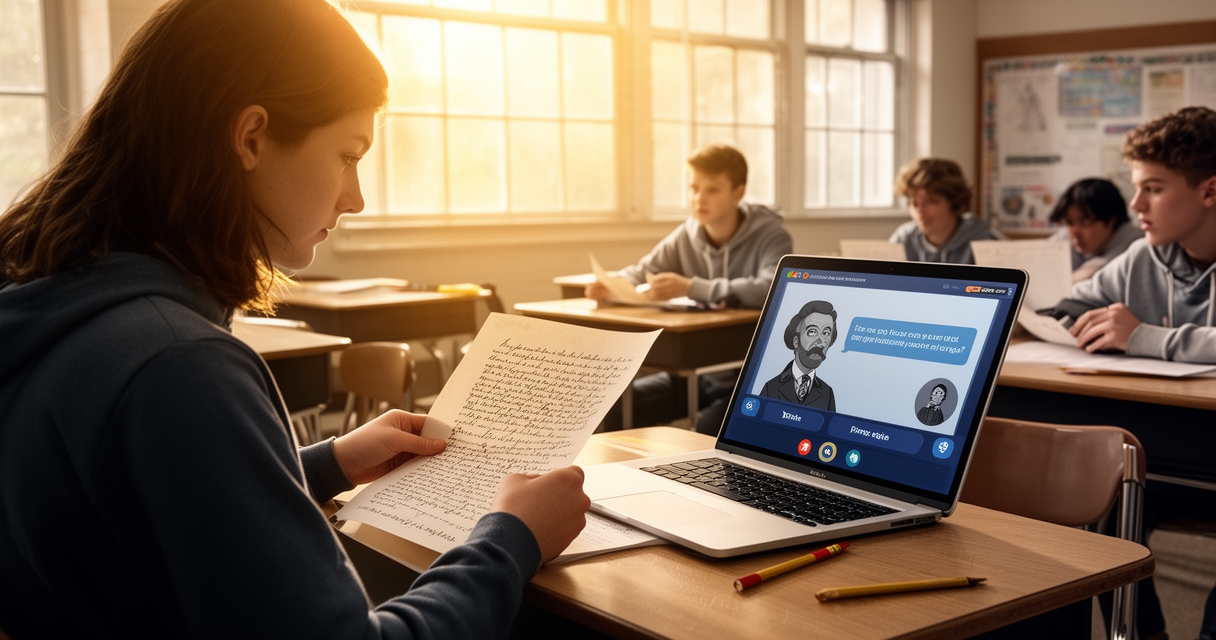
The sweet spot is AP and IB classrooms built around sustained inquiry. A student holding an extended conversation with a primary-source-grounded Lincoln or Harriet Tubman, then submitting that transcript for AI-graded reflection, is a pedagogy that has no close equivalent in MagicSchool or Curipod. The assignment builder structures that inquiry as a formal product. That combination is what the $129/year is paying for.
A word on privacy claims: Humy’s vendor-stated posture is school-facing, and the company reports 80-plus school and district partners. Those are vendor-stated figures. Before deploying Humy student-facing, districts should verify current DPA status with district IT — the number of partners and the existence of a compliance framework are not, by themselves, confirmation of a signed agreement with a specific district. Independent review volume is low (around five reviews on Trustpilot at the time of writing), which makes third-party validation thin.
The weak spots are straightforward. At $129/year, Humy costs more than the free MagicSchool-Diffit-Curipod stack combined. The learning curve on the assignment builder is genuine — this is not a plug-and-play tool for a teacher testing AI for the first time. And for standard units in grades 6–8, the depth Humy offers exceeds what most curricula call for.
Humy is a strong call for AP US History, AP World History, and IB History. It is not the right first tool for most social studies teachers.
Hello History (Consumer App): Do Not Deploy Student-Facing Without a DPA
Hello History (hellohistory.ai) is a consumer application. Over 400 historical figures, free credits on sign-up, or $99/year for expanded access. It is visually polished, the figure interactions are engaging, and it costs less than Humy’s Teacher Pro tier.
The problem is the classification: consumer-first, not education-first.
If students under 13 use a consumer app that has not been reviewed and approved under a district data processing agreement, the school — not the app vendor — bears FERPA and COPPA liability. This is not a hypothetical risk. A teacher on r/Teachers framed the stakes plainly: “3,000 students’ sensitive info discovered from an AI company.” The specific app in that comment is not the point. The principle is: districts that skip the DPA review process own the exposure.
Regarding Hello History specifically: a district DPA process at the same scale and documentation level as Humy’s school-facing platform could not be confirmed at publication. The phrasing here is deliberate — the absence of confirmed documentation is not proof that no documentation exists. What it means practically is that teachers should not assume consumer-grade approval is equivalent to district-reviewed compliance. Ask district IT before assigning any student interaction with this app.
The appropriate use case is teacher prep. Hello History is a useful personal research tool for a teacher building a unit around a historical figure. Assigning it to students is a separate question, and that question requires a district IT answer, not a teacher judgment call.
Diffit: The Best Free AI Tool for Social Studies Differentiation
Diffit takes a URL, PDF, or pasted text and levels it to any target grade, translates it, and generates vocabulary and comprehension questions. For social studies, the use case is direct: paste a Library of Congress primary source, set the reading level for struggling readers or ELL students, export the PDF.
The free tier covers full lesson creation and PDF export. Individual plans run $14.99/month or $149.99/year at publication — check the official pricing page. Diffit is FERPA and COPPA compliant and does not sell or collect student data, which simplifies the district review conversation considerably.
The community evidence for this tool is some of the strongest in the social studies AI space. A teacher on r/Teachers described using Diffit to level the Canadian Charter of Rights and Freedoms for a Grade 2 class — “would have taken two preps” to produce equivalent materials manually. That specific example captures the value: the tool doesn’t just simplify vocabulary, it restructures the content to match the developmental level, in under a minute.
The case for Diffit in a social studies classroom is nearly universal. Primary sources are the core of the discipline. They are also almost universally written above the reading level of the students expected to analyze them. Any class with struggling readers — which is most classes — has a leveling problem. Diffit solves it without a subscription and without privacy risk.
This is also the tool most relevant to special education contexts in SS. Differentiated primary source access is foundational to IEP-aligned instruction. The best AI tools for special education teachers covers the broader accessibility toolkit, but Diffit belongs in that conversation regardless of the IEP context.
Curipod: Free Interactive Lesson Delivery for History and Social Studies
Curipod generates interactive slide decks with polls, open-response questions, peer voting, and real-time feedback in roughly 30 seconds from a text prompt. For social studies, the delivery layer is where Curipod earns its place: historical dilemma scenarios, debate openers, live primary source analysis with class-wide response, and structured Socratic setups.
The free tier is genuinely full-featured, not a trial. Curipod functions as a Nearpod or Pear Deck replacement with AI generation built in. It does not create leveled text (Diffit’s job). It does not ground responses in primary sources (Humy’s job). It delivers the lesson interactively, which neither Diffit nor Humy does.
Search interest in Curipod has grown substantially — reported growth of approximately 397% year-over-year, though the underlying data source and baseline period for that figure should be treated as approximate. The growth directionally matches what teachers on r/Teachers describe: a tool that entered widespread use quickly because the free tier does not degrade meaningfully relative to paid alternatives.
The practical stack position for Curipod is the delivery layer. MagicSchool generates the lesson plan, Diffit levels the primary source, Curipod delivers the discussion interactively. Each tool is doing the job it was built for.
Our Take: The Stack That Actually Makes Sense
The framing most AI roundups apply to this space is wrong. This is not a question of MagicSchool versus Humy, or whether to choose a specialist over a generalist. These tools are not substitutes for each other — they are components.
The default stack for a social studies teacher starting with AI tools is MagicSchool AI plus Diffit plus Curipod. Total cost: $0. MagicSchool handles lesson planning, differentiation scaffolds, and administrative writing. Diffit handles primary source leveling. Curipod handles interactive delivery. Together, they cover the full lesson cycle.
Humy at $129/year is the right add-on for a specific condition: an AP or IB class where sustained primary-source inquiry is central to the curriculum, not an occasional activity. At that point, the assignment builder and AI-graded work products justify the cost. For a standard grades 6–8 unit on the Civil War, they do not.
Vendor claims about time savings — figures like seven to ten hours per week are common in edtech marketing — should be treated as marketing until validated in a specific teacher’s context. The free stack described here has been reported as high-leverage by teachers in the community. The hours saved depend entirely on how the tools are integrated and whether the teacher adapts the outputs or uses them as-is.
The consumer Hello History app is a useful personal research tool. It is not a classroom deployment until district IT has reviewed and signed off on a DPA. That sign-off process exists for reasons unrelated to the quality of the app.
For teachers exploring AI grading alongside these tools, best AI grading tools for teachers in 2026 covers the landscape in detail.
Frequently Asked Questions
Is Humy worth it compared to MagicSchool?
For most social studies teachers, no. MagicSchool’s free tier covers lesson planning, differentiation, and administrative tasks that represent the majority of daily AI use. Humy earns its $129/year Teacher Pro cost only in AP or IB classrooms where sustained primary-source dialogue and AI-graded inquiry products are central to the course design, not occasional additions.
Which tool lets students talk to historical figures in a classroom-safe way?
Humy is the school-facing option built for this purpose, with a vendor-stated school and district partner base and a privacy posture designed for educational deployment. Before assigning student-facing historical figure interactions, verify that a DPA is in place with district IT — vendor-stated posture is not the same as a signed district agreement. The consumer Hello History app should not be used student-facing without completing that same review process.
What are the best free AI tools for history teachers?
MagicSchool AI (free tier, no trial expiry), Diffit (free tier with full lesson creation and PDF export), and Curipod (genuinely full-featured free tier) together cover lesson planning, primary source differentiation, and interactive delivery. All three are free. That stack handles the majority of AI-assisted social studies instruction without a subscription.
How do AI tools differentiate social studies content for struggling readers?
Diffit is the clearest answer. Paste a primary source URL, PDF, or text, select the target reading level, and Diffit restructures the content — vocabulary, sentence complexity, and comprehension questions — for that level. MagicSchool can generate simplified summaries, but Diffit’s differentiation is more granular and designed specifically for the leveling task. Both tools export materials teachers can distribute without exposing student data.
Is a subject-specific platform better than MagicSchool for social studies?
In most cases, no. The majority of tasks social studies teachers reach for AI to handle — planning, scaffolding, email drafting, generating discussion questions — fall within MagicSchool’s toolkit. A subject-specific platform like Humy addresses one workflow (historical figure inquiry) that MagicSchool was never designed to support. The question is not which platform is better overall but whether the specific task the subject-specific platform solves appears regularly enough in the curriculum to justify the cost.
The Verdict for Social Studies Teachers
The free stack — MagicSchool AI, Diffit, and Curipod — covers the full lesson cycle for most social studies classrooms at zero cost. That is the starting point, not a fallback.
Humy at $129/year is a legitimate upgrade for AP US History, AP World History, or IB History classes where primary-source inquiry is the pedagogical backbone. For standard units, the free stack is sufficient.
Hello History stays in the teacher prep role until a district DPA is signed. The app is engaging. The compliance question is real. The school bears the risk if that sequence is skipped.
The practical next step: start with MagicSchool and Diffit this week. Use MagicSchool’s free trial of the Plus tier if available, use Diffit’s free tier with a primary source from an upcoming unit, and run one Curipod session on a debate or dilemma question. Evaluate Humy’s free Explore tier only after that stack has been used for at least a semester and a specific gap remains. That gap, if it exists, is the one Humy is priced to fill.
References
- MagicSchool AI official site: magicschool.ai
- Humy official site: humy.ai
- Hello History official site: hellohistory.ai
- Diffit official site: diffit.me
- Curipod official site: curipod.com
- r/Teachers community discussions on AI tools for differentiation and ELL scaffolding (Reddit, accessed July 2026)
- Curipod reported growth figure (~397% YoY): approximate; verify against current Curipod public data
- Humy Trustpilot reviews: trustpilot.com/review/humy.ai (approximately 5 reviews at time of writing)